



Executives are surrounded by tools for managing performance. Calendars organize time, dashboards track revenue, project software monitors execution, and wearables increasingly measure sleep, heart rate, and recovery. Yet one part of performance is still often handled informally: how a leader comes down from sustained cognitive and emotional pressure after the workday ends.
That matters because leadership stress is rarely limited to the hours spent in meetings. A CEO may leave the office but continue replaying a difficult conversation, thinking through an acquisition, or checking messages before bed. The body may be sitting still while the mind is still solving problems. Over time, that pattern can affect sleep, attention, patience, and decision quality. This is why executive recovery is becoming less of a lifestyle topic and more of a performance strategy.
Recovery does not mean avoiding pressure or trying to stay relaxed all day. Senior leaders are paid to make decisions under uncertainty, manage conflict, and stay functional when the stakes are high. The practical goal is to make sure periods of high demand are followed by a reliable recovery routine. That is also where interest in the stress management device is growing. The useful question is not whether technology can remove executive stress, but whether the right tool can help make recovery more consistent, easier to start, and more realistic during busy weeks.
Why Executive Stress Is Hard to Switch Off
Leadership stress is different from simply having a long to-do list. Executives move repeatedly between different kinds of cognitive work: strategic planning, financial judgment, personnel decisions, negotiations, public communication, and crisis response. Each task requires a different mental frame, but there is often little time to reset between them. A leader may spend one hour reviewing a forecast, the next handling a sensitive employee issue, and the next defending a decision to investors. The workload is not only large; it is mentally fragmented.
This constant switching increases cognitive load. Working memory has limited capacity, and repeated decision-making can make it harder to maintain the same quality of attention late in the day. The signs may be subtle. A leader may become more impatient, choose the familiar option instead of examining alternatives, postpone a difficult conversation, or respond too quickly to something that would have benefited from another hour of thought. None of this requires dramatic burnout. Small changes in judgment can matter when the person making the decision influences an entire team or business.
The problem continues when the workday technically ends but the cognitive load does not. Checking email at dinner, reviewing numbers in bed, or mentally rehearsing tomorrow’s meeting keeps the brain connected to the same stream of demands. This is one reason executives can feel exhausted and still struggle to slow down. They do not always need more free time first; they often need a clearer transition between performance mode and recovery mode.
Why Recovery Routines Are Becoming More Structured
The most effective recovery habits are not especially glamorous. Sufficient sleep opportunities, regular exercise, time away from work, sensible caffeine and alcohol habits, and a calmer evening environment still do most of the heavy lifting. The problem is consistency. These habits are usually the first things to disappear when travel, deadlines, or an important deal takes over the calendar.
That is why executive recovery works better when it is designed rather than improvised. A recovery routine gives the end of the workday a recognizable structure. It might start with a walk after the last meeting, followed by a shower, a short breathing practice, dinner without email, and a fixed point when work notifications stop. Another executive may use exercise earlier in the day and reserve the evening for reading or a short relaxation session. The details matter less than the repeatability.
The reason structure helps is simple: when someone is already mentally overloaded, they are less likely to make another good decision about how to recover. A predefined routine removes that decision. It creates a familiar sequence that tells the body and mind that the high-demand part of the day is ending.
For executives who already understand the basics but struggle to create that transition consistently, different categories of wellness technology for stress management are becoming part of the conversation. These tools can include wearables that monitor stress-related signals, breathing and biofeedback systems, guided relaxation devices, and nervous-system-focused technology. Their value should be judged by whether they support a repeatable recovery behavior, not by whether they promise to eliminate stress altogether.

Where a Stress Management Device Fits Into an Executive Routine
A stress management device is most useful when it solves a specific problem. That sounds obvious, but many people buy wellness technology in the opposite order: they see an interesting product first and only later try to find a reason to use it. For executives, the better approach is to identify where the recovery routine is breaking down.
If the problem is awareness, a wearable tracker may be enough. Sleep duration, resting heart rate, and recovery trends can help show whether long workdays or frequent travel are starting to accumulate. If the problem is that the leader knows they are stressed but never actually pauses, a breathing or biofeedback tool may be more useful because it creates a structured activity. If the problem is difficulty transitioning out of work mode, a nervous-system-focused device may fit as a short, repeatable session at the start of the evening.
These categories should not be treated as interchangeable. A tracker measures. A biofeedback device helps a user respond to measured signals. A stimulation-based product actively delivers a physical stimulus. Each has a different role, and the right choice depends on what the executive is trying to change.
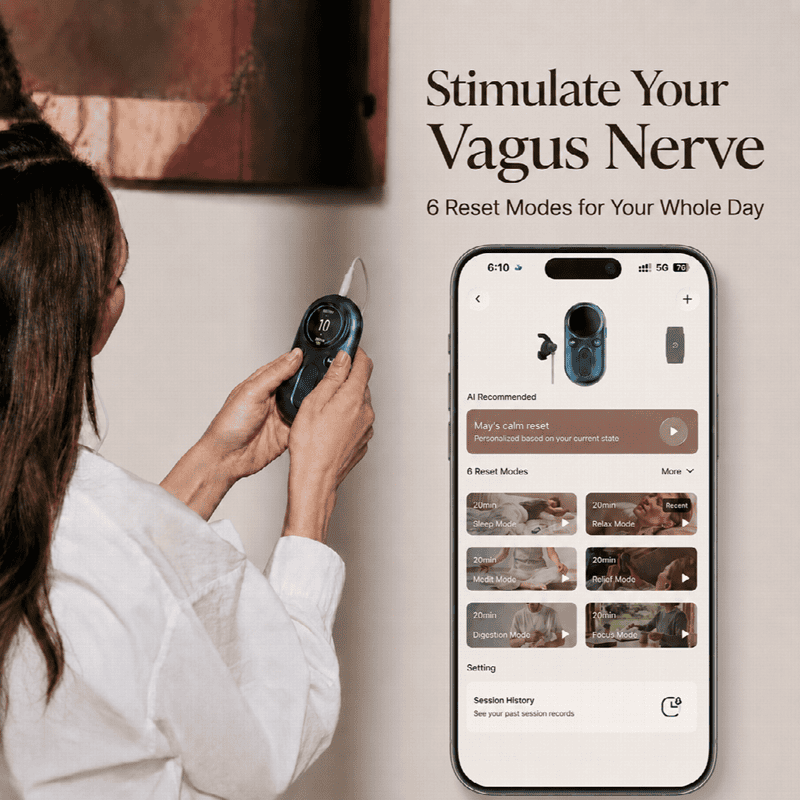
This is why a practical stress relief device guide can be more useful than a list of “best” products. The important comparison is not which device has the most features. It is whether the technology matches the problem, whether the user can fit it into a real schedule, and whether the claims made for the device are supported by the type of technology being used.
Not Every Stress Management Device Does the Same Job
The term stress management device now covers several very different product categories, and that can make shopping confusing. Some devices are primarily observational. They track metrics such as heart rate variability, sleep, or resting heart rate and help users notice patterns. Others are behavioral tools that guide breathing, meditation, or relaxation exercises. A third group uses forms of non-invasive stimulation and is designed around more direct interaction with the nervous system.
| Device Type | Main Role | When It May Be Useful |
| Wearable tracker | Measures sleep, activity, heart rate, or recovery trends | When the main problem is lack of visibility into daily patterns |
| Biofeedback or breathing device | Uses feedback or guidance to support a structured calming exercise | When the user needs help turning awareness into a repeatable practice |
| Nervous-system-focused device | Uses non-invasive stimulation as part of a wellness routine | When the user wants an active, session-based tool rather than another dashboard |
This distinction matters because a leader who already owns a smartwatch may not need another device that produces a recovery score. They may need something that helps them act on the information they already have. On the other hand, someone who has no idea how poor sleep, late meals, or travel affect them may benefit more from measurement before adding another intervention.
The best stress technology therefore depends on the gap in the routine. If the gap is information, measure. If the gap is behavior, guide. If the gap is the transition itself, consider whether a session-based tool makes sense. Starting with the problem keeps technology in a supporting role rather than allowing it to become another source of complexity.
Why Nervous-System-Focused Devices Are Getting More Attention
One reason nervous-system-focused technology is gaining attention is that stress is not only a mental experience. High-demand periods are accompanied by changes in breathing, heart activity, muscle tension, alertness, and other physiological processes. The autonomic nervous system helps coordinate many of these changes as the body responds to what is happening around it.
Consumer wellness language often simplifies this into a sympathetic “stress mode” and a parasympathetic “relaxation mode.” That explanation is useful at a basic level, but the real system is more dynamic. Both branches of the autonomic nervous system are constantly adjusting to context. The goal of a recovery routine is not to force the body into one permanent relaxed state. It is to create conditions that make it easier to transition away from unnecessary sustained activation when the demanding part of the day is over.
Vagus nerve stimulation is one area being explored within this broader category. The vagus nerve is involved in communication between the brain and body and is closely connected with autonomic function. Medical VNS has a long history in implanted systems, while newer non-invasive approaches use external stimulation. These are not the same technology, and research from implanted medical systems should not be automatically applied to consumer wellness products.
For an executive considering a stimulation-based stress management device, the practical questions are straightforward. Where is stimulation delivered? Is the device intended for general wellness or a medical use? Are instructions clear? Is the session comfortable enough to repeat? Does the company distinguish research on the broader technology from evidence on the specific product? Those questions are more useful than a dramatic claim about “resetting” the nervous system.
What Leaders Should Look for Before Choosing a Stress Management Device
Executives are used to evaluating investments by asking what problem is being solved, what evidence supports the solution, and what the downside is. The same logic works well when choosing recovery technology. A product should first have a clear role in the routine. If a leader cannot explain when they would use it and what behavior it is supposed to support, the device will probably end up in a drawer.
Usability matters more than people expect. A twenty-minute session that can be started immediately may be realistic at the end of a busy day. A tool that requires complicated setup, constant app navigation, or uncomfortable placement may not survive a week of travel and late meetings. Consistency is one of the biggest advantages of any recovery routine, so friction is a real performance issue.
Evidence also needs to match the device. Research on stress, breathing, HRV, neuromodulation, or vagus nerve stimulation does not automatically validate every product using those concepts. Different devices may use different targets, stimulation parameters, protocols, or intended uses. A credible product should explain those distinctions rather than borrowing the strongest claim available from the broader scientific field.
Finally, leaders should ask whether the device makes the recovery process simpler. The point of a stress management device is not to create another metric to optimize or another app to check throughout the day. The best tool reduces friction. It provides a clear cue, a structured session, or useful feedback that helps the user move from “I know I should recover” to actually doing it.
Recovery Data Should Guide Decisions, Not Become Another Performance Score
Many executives already track HRV, resting heart rate, sleep duration, or readiness through a smartwatch or ring. These data can be useful when viewed over time. A leader may notice that three late dinners in a row affect sleep, that international travel takes longer to recover from than expected, or that a demanding work week combined with heavy training produces a predictable drop in readiness.
The mistake is treating every daily score as a verdict. HRV can change with sleep, exercise, illness, alcohol, breathing, posture, and normal variation. A poor recovery score does not necessarily mean the day should be cancelled, and a high score does not mean fatigue should be ignored. Data works best when it helps leaders make small, sensible adjustments rather than when it becomes another source of pressure.
This matters especially for high performers because optimization itself can become stressful. If every night of sleep, every meal, every workout, and every recovery score turns into a target, wellness starts to resemble another job. A good recovery system should make decision-making easier. It should help a leader recognize patterns and act on them without feeling controlled by a dashboard.
Executive Recovery Works When It Is Simple Enough to Survive a Busy Week
The most effective recovery plan is rarely the most sophisticated one. It is the one that still exists when the executive is travelling, the company is closing a quarter, or the calendar is full. Sleep, exercise, reasonable boundaries, and time away from work remain the foundation. Technology should sit on top of those basics, not replace them.
A useful routine might be surprisingly simple: finish the last work block, step away from screens, take a short walk, complete a ten- or twenty-minute recovery session, eat dinner, and stop returning to email unless something is genuinely urgent. Another leader may prefer exercise, breathing, or a quiet period before sleep. What matters is that the sequence is predictable enough to become automatic.
A stress management device can support that system if it provides a useful cue or session that the executive is willing to repeat. It becomes less useful when it is treated as a rescue tool after several weeks of poor sleep, constant travel, and nonstop work. No device can make an unsustainable schedule sustainable by itself.
Recovery Is Becoming Part of the Executive Performance System
The business case for executive recovery is not that leaders should avoid stress. High responsibility naturally creates demanding periods. The case is that sustained performance requires a way to recover from those periods before cognitive load becomes the default state. Decision quality, attention, patience, and strategic thinking all depend on resources that are harder to maintain when work continuously spills into sleep and personal time.
That is why stress management technology is becoming more relevant to leadership. The market is moving beyond simple tracking toward tools that help users build repeatable responses. Some executives will benefit most from better data. Others need a breathing or biofeedback routine. Some may explore nervous-system-focused technology as part of a structured wind-down. The right choice depends on the gap in the individual recovery system.
The strongest performance strategy is still the least dramatic one: identify where recovery is breaking down, protect the basics, choose tools that solve a real problem, and repeat the routine often enough for it to become normal. When technology supports that process instead of replacing it, executive recovery stops being a vague wellness idea and becomes something much more practical: a way to preserve the quality of performance over time.
References
- Lim J, Dinges DF. A Meta-Analysis of the Impact of Short-Term Sleep Deprivation on Cognitive Variables. Psychological Bulletin. 2010.
- Killgore WDS. Effects of Sleep Deprivation on Cognition. Progress in Brain Research. 2010.
- McEwen BS. Protective and Damaging Effects of Stress Mediators: Central Role of the Brain. Dialogues in Clinical Neuroscience. 2006.
- Hockey GRJ. Compensatory Control in the Regulation of Human Performance Under Stress and High Workload: A Cognitive-Energetical Framework. Biological Psychology. 1997.
- Yap JYY, Keatch C, Lambert E, Woods W, Stoddart PR, Kameneva T. Critical Review of Transcutaneous Vagus Nerve Stimulation: Challenges for Translation to Clinical Practice. Frontiers in Neuroscience. 2020.

