




For small businesses, WhatsApp has become part of everyday operations. A customer asks about a delivery, a salesperson follows up on a quote, and an employee confirms an appointment. These exchanges may seem routine, but the cost of handling them has changed.
On October 1, 2026, Meta introduced new charges for certain customer-service messages sent through the WhatsApp Business Platform. Businesses that previously relied on unlimited free service replies now have a monthly allowance before additional charges apply.
For business owners, the immediate concern is understandable: Will customer conversations become more expensive, and is their current messaging setup still worth the cost?
The answer depends on message volume, recipient location, and the tools a business actually needs.
What Changed in WhatsApp Business Pricing in October 2026?
The update primarily affects companies using the WhatsApp Business Platform, commonly referred to as the WhatsApp Business API.
Two changes matter most.
- Customer-service replies are no longer free without limit.
Businesses previously could send unlimited free-form replies within an active 24-hour customer service window without incurring Meta’s message delivery charges.
Now, each business phone number receives 1,000 free delivered service messages per month. Once that allowance is exhausted, additional service messages are billed according to the recipient’s market.
- Utility templates sent inside the customer service window are now chargeable.
Order confirmations, shipping updates, and appointment notifications sent as utility templates may incur charges even during an active customer service window.
Marketing and authentication templates continue to follow their existing category-based pricing rules.
Here is a simplified comparison:
| Message type | Before October 1 | From October 1, 2026 |
| Service replies within 24 hours | Free | First 1,000 per number/month free; additional messages charged |
| Utility templates within 24 hours | Generally free | Charged at applicable utility rates |
| Marketing templates | Charged | Charged |
| Authentication templates | Charged | Charged |
| Incoming customer messages | Free | Free |
Qualifying free-entry-point conversations remain subject to separate exemptions.
One distinction is especially important: these changes concern the WhatsApp Business Platform, not ordinary conversations conducted through the free WhatsApp Business App.
Does 1,000 Free Messages Mean 1,000 Customer Conversations?
No. This is where business owners can easily underestimate their messaging volume.
The allowance applies to individual delivered service messages, not complete conversations.
Consider a furniture retailer handling a delivery inquiry:
- The customer asks when an order will arrive.
- An employee confirms the expected delivery date.
- The employee sends tracking information.
- The customer asks whether someone must be home.
- The employee replies with delivery instructions.
That single customer conversation contains three outbound service replies.
If a business handles 400 similar conversations each month, averaging six qualifying outbound replies per conversation, it could send approximately 2,400 service messages.
After the first 1,000, the remaining 1,400 would become chargeable.
This distinction matters because companies often measure workload by customer conversations, while the updated pricing measures qualifying individual messages.
What Will Small Businesses Actually Pay?
The financial impact may be smaller than some business owners expect, although costs vary substantially across markets.
Consider a company using one WhatsApp Business Platform phone number to communicate with customers in the United States.
During a typical month, it sends:
- 2,400 service replies
- 300 utility template messages
- No messages eligible for additional free-entry-point exemptions
Using the October 2026 North American rate of $0.0034 per delivered service or utility message, the estimated Meta charges would be:
| Message category | Calculation | Estimated cost |
| First 1,000 service messages | Free allowance | $0.00 |
| Additional 1,400 service messages | 1,400 × $0.0034 | $4.76 |
| 300 utility messages | 300 × $0.0034 | $1.02 |
| Monthly Meta messaging charges | $5.78 |
This is an illustrative estimate based on a single recipient market. Actual charges depend on message delivery, category, destination, exemptions, and applicable pricing tiers.
Businesses also need to account for any software subscriptions or fees charged by their WhatsApp API provider.
For a small company, an additional $5.78 may not justify changing its entire customer communication system.
However, the calculation highlights a larger issue: the cost of messaging software, employee time, and inefficient workflows may be more significant than the message delivery charges themselves.
WhatsApp Business App, API, or Sender Tool: Which Does Your Business Need?
The October pricing update provides a useful opportunity to reassess the tools employees use every day.
Different WhatsApp solutions serve different business requirements.
| Solution | Suitable business needs | Key consideration |
| WhatsApp Business App | Handling direct customer inquiries and everyday conversations | Limited advanced integration capabilities |
| WhatsApp Web sender tools | Preparing personalized messages and managing permitted outbound campaigns | Browser-based workflows and account policy requirements |
| WhatsApp Business API | Connecting CRM systems, managing complex support operations, and using approved messaging templates | Platform charges, implementation, and provider costs |
For companies operating customer support centers or requiring advanced CRM integration, the official Business Platform may provide capabilities that justify its costs.
Smaller businesses may have different priorities.
Imagine a retailer preparing a product restock announcement for customers who have agreed to receive updates. Its employees already have the contact information in a spreadsheet and simply need an organized way to prepare personalized messages.
In this situation, a WhatsApp Sender such as RocketSender can help the team import Excel contacts, create personalized messages, and prepare campaigns through a web dashboard. Actual sending takes place through its Chrome extension in WhatsApp Web, without requiring an API integration.
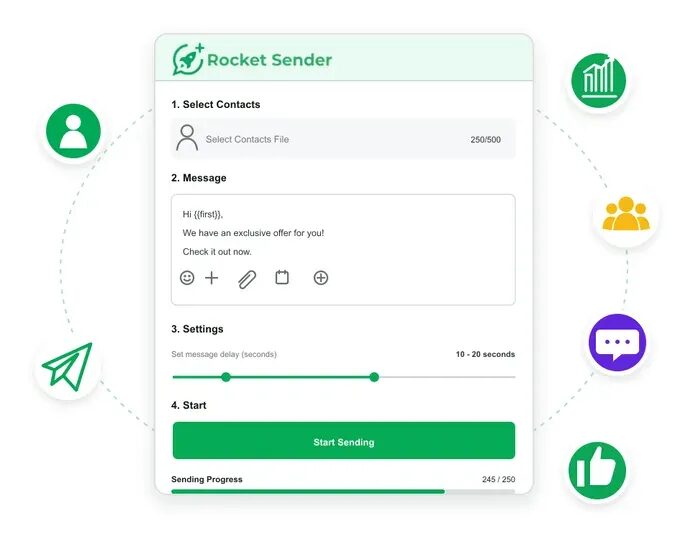
This approach focuses on organizing outbound messaging rather than providing the enterprise integrations and customer-service infrastructure of the Business Platform.
It is not a replacement for every API feature. Instead, it addresses a more straightforward operational need.
When Is a Browser-Based Sender Enough?
Not every business needs a dashboard connected to multiple CRM systems or an automated customer support platform.
Consider a local service provider sending appointment reminders to customers who have opted in to receive them.
The company maintains an Excel sheet containing customer names, phone numbers, and appointment information. Employees currently copy details into WhatsApp Web, update each message manually, and keep track of completed reminders.
The challenge is repetitive administration rather than enterprise-level automation.
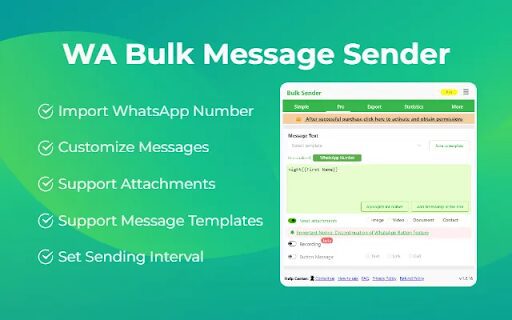
A Free WhatsApp Sender extension such as WA Bulk Message Sender provides a browser-based approach to importing Excel contacts, personalizing outgoing messages, and monitoring sending progress within WhatsApp Web. Its available free and paid features, including sending allowances, should be reviewed before selecting a plan.
For teams handling straightforward, permission-based communication, these capabilities may help reduce repetitive preparation.
However, browser extensions have different limitations from official API integrations.
They should not be assumed to provide shared CRM records, enterprise-grade support routing, or unrestricted sending. Using a browser-based tool also does not guarantee protection from WhatsApp account restrictions.
The right solution depends on the complexity of the business’s communication needs, not simply the number of messages it intends to send.
How to Reduce WhatsApp Communication Costs Without Sacrificing Customer Experience
Businesses reviewing their messaging expenses should look beyond API rates and software subscriptions.
Three operational improvements can make a meaningful difference.
1. Stop measuring success by the number of messages sent
Sending 1,000 messages provides little business value if almost nobody responds.
A more useful measurement is the number of meaningful conversations generated, appointments confirmed, customer issues resolved, or sales opportunities advanced.
For example, a business receiving 30 qualified responses from 200 relevant messages may achieve a better outcome than one sending 1,000 generic promotions to an uninterested audience.
The goal should be useful communication, not maximum volume.
2. Organize contact information before sending
Incomplete or outdated contact records create unnecessary work.
Before starting a campaign, teams should verify contact details, confirm the intended audience, and make sure recipients have agreed to receive the relevant messages.
Basic segmentation can help businesses distinguish between existing customers, pending inquiries, and customers awaiting a specific update.
That makes personalization more useful and reduces unnecessary messages.
3. Match software capabilities to actual requirements
A company should not pay for advanced integrations its employees never use.
At the same time, it should not choose a lightweight tool if its customer service operation requires a shared inbox, complex routing, and detailed CRM records.
Reviewing real workflows often reveals whether the business needs better organization, a simpler sending tool, or a more capable platform.
The least expensive subscription is not necessarily the most economical solution if it creates additional manual work.
Responsible Messaging Still Matters
The October pricing changes do not alter a fundamental requirement of business communication: customers should receive messages they have agreed to receive.
Businesses should maintain appropriate consent records, respect opt-out requests, and avoid sending repetitive or unwanted promotions.
WhatsApp may restrict accounts based on violations of its policies or problematic messaging behavior. There is no universal sending volume or timing interval that guarantees an account will remain unrestricted.
Whether a business uses the official API, the Business App, or a browser extension, responsible communication practices remain essential.
Frequently Asked Questions
Is WhatsApp Business charging for every message in October 2026?
No. The new charges concern qualifying messages sent through the WhatsApp Business Platform. The free WhatsApp Business App does not automatically follow the same API per-message billing model, although some premium features may have separate charges.
Are the first 1,000 WhatsApp messages free?
The first 1,000 qualifying service messages per business phone number are free each month on the WhatsApp Business Platform. This allowance does not apply to every message category.
Is a WhatsApp sender extension the same as the Business API?
No. A browser extension works through WhatsApp Web and supports particular messaging workflows. The Business API provides official programmatic messaging, approved templates, and broader integration capabilities.
Can businesses avoid WhatsApp restrictions by using a sender tool?
No. Businesses must follow applicable WhatsApp policies, respect recipient preferences, and avoid unauthorized messaging regardless of which tool they use.
The Bigger Lesson for Small Businesses
Meta’s October 2026 pricing update makes customer-service messaging costs more visible for businesses using the WhatsApp Business Platform.
But it does not automatically mean every business needs to change its software.
For some companies, the new charges will represent only a modest increase. Others may need to review message volumes, operating markets, and service-provider fees more carefully.
The more important decision is whether the existing messaging workflow matches the business’s needs.
Small teams handling occasional outreach may benefit from simpler processes. Growing customer support operations may require deeper integrations and more comprehensive infrastructure.
Ultimately, an effective messaging strategy is not defined by how many messages a company can send.
It is defined by whether the company can communicate with the right customers, respond to their needs, and manage those interactions efficiently as the business grows.
Pricing information reflects WhatsApp Business Platform changes effective October 1, 2026. Businesses should verify current Meta rates and service-provider charges before making financial decisions.