




On August 27, 2026, Virtu Financial, M1X Global and Tradeweb announced a completed repo using a sovereign digital bond as collateral. The securities, cash, and return settled on the Canton network. The financing remained a repo; what changed was the ledger recording the collateral and the way its transfer was coordinated with cash.
A repo, short for repurchase agreement, involves selling securities for cash and committing to buy them back at an agreed time. It functions as secured short-term financing. The securities provide collateral, while the repurchase agreement establishes how the funding ends. Tradeweb’s transaction announcement describes that structure using a digitally native bond.
What Tokenized Collateral Represents
Tokenized collateral is a financial asset issued or represented on a blockchain and used to secure a transaction. AlphaWire’s account of how Wall Street is moving repo collateral onchain describes bonds and funds taking on this role in institutional financing. Their digital form becomes useful when the asset can be transferred and recorded as part of the funding arrangement.
The instrument in the August repo was USDM1, a sovereign digital bond issued by the Republic of the Marshall Islands and backed by short-dated US Treasuries. These securities performed different jobs. USDM1 was the collateral exchanged in the repo; the Treasuries backed that bond. Calling the transaction a tokenized Treasury repo would blur the distinction between the instrument being financed and the assets supporting it.
Tokenization can represent an existing security, while a digitally native security is issued directly on the blockchain. USDM1 was itself a bond issued directly onchain, rather than a ledger representation of an existing US Treasury security. In either case, participating institutions use ledger records to identify the instrument and its transfers. Conventional securities markets already use electronic records. What changes here is the connection between an asset recorded on a shared ledger and the coordinated exchange of that asset for cash.
The Two Exchanges in a Repo
The opening exchange places securities with the cash provider and cash with the institution seeking funding. The later repurchase reverses those movements under the agreed terms. The repurchase obligation distinguishes the arrangement from a sale that simply ends the seller’s involvement with an asset. The agreed repurchase time defines the funding period, and the repurchase price defines the amount payable when it ends. The difference between the initial cash amount and the repurchase price represents the financing cost. Those commercial terms remain part of the arrangement when its settlement moves onto a blockchain.
Moving this activity onchain changes the records and settlement process through which those exchanges occur. An asset record identifies what is being transferred, while settlement completes the exchange between the parties. Trade execution and settlement have different jobs: agreeing to the transaction establishes its terms; completing settlement delivers the securities and payment. A blockchain-based asset still needs a working connection between those functions. The August repo was agreed on Tradeweb’s platform and settled on Canton, connecting those two functions in the reported transaction. The announcement describes a deal between two institutional counterparties.
Atomic settlement means the securities delivery and cash payment complete together, or neither completes. The repo contains two such paired exchanges: one starts the financing, and the other closes it through repurchase. Coordinating each pair keeps the movement of collateral tied to the corresponding payment. The two exchanges remain separate events, with the agreed funding period between them.
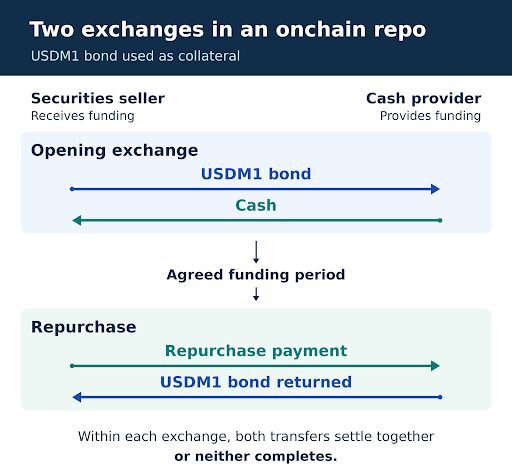
Tradeweb reported that the August repo cycle, including execution and repurchase, finished in under 10 minutes. The figure covers this transaction’s funding and return, rather than the settlement speed of a single transfer. A repo’s agreed funding period remains separate from its settlement process.
Connecting a Trade to Market Infrastructure
A completed transaction establishes that a particular combination of instruments, counterparties, and systems worked. Wider use requires infrastructure that can support repeatable transactions across institutions and asset types. Collateral has an operational role after issuance, and the systems surrounding it determine where that role can be performed.
In May 2026, the Depository Trust & Clearing Corporation (DTCC), a market infrastructure provider, described its Collateral AppChain infrastructure as a common layer for different tokenized assets and connections between blockchain networks. Its account emphasized scalability, reliability, and integration with existing market structures, and included tokenized securities and money market funds among the asset types it discussed. The proposed approach supports connections between networks without requiring the whole market to converge on a single blockchain.
DTCC also described a move toward a common pool of assets available for different collateral uses. Its stated aims include making collateral easier to locate and move between uses. The technical layer handles asset records and movement; counterparties still agree which securities support their financing. This extends the infrastructure question beyond recording one bond on one network to making assets usable across the systems institutions work with. The proposed pool brings different assets within shared infrastructure while preserving the financial identity of each. The August repo provides a completed example of a digital bond’s use, rather than evidence that all such infrastructure is already operating.
The collateral’s economic role remains recognizable: a bond supports temporary funding and comes back at repurchase. The operational change is the connection between its ledger record and the cash transfers that complete each exchange. Tokenization reaches into the core financial system through that connection, when institutions use the digital instrument to carry out an existing financing function.

