



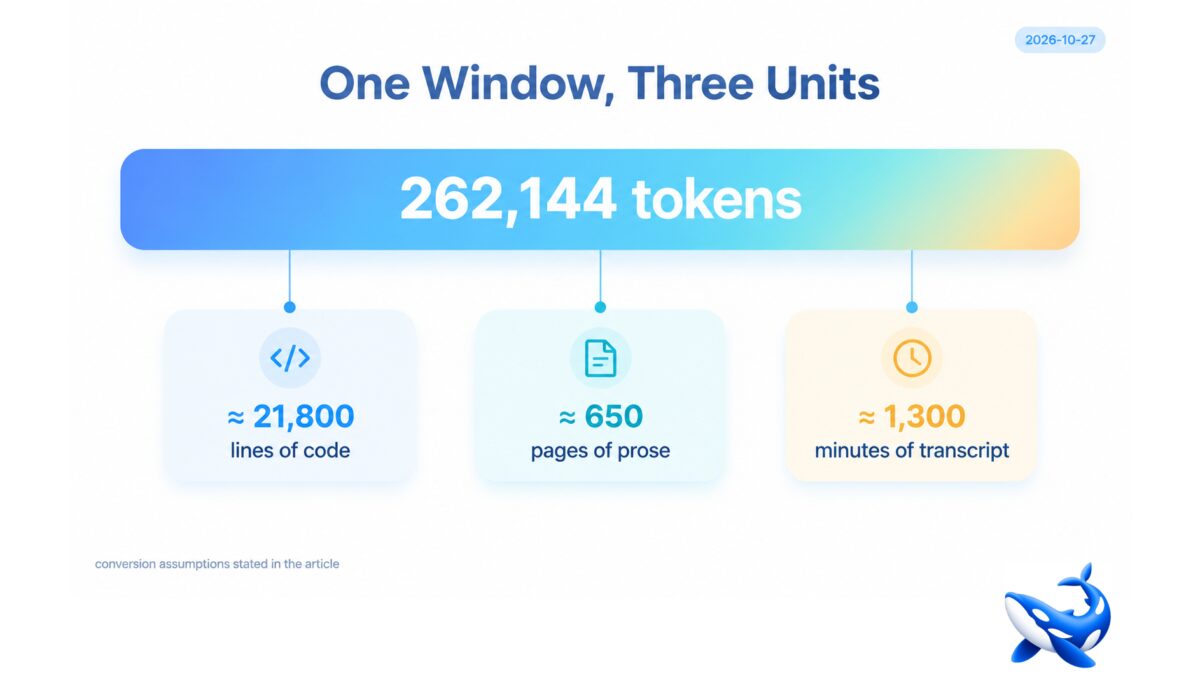
Through OrcaRouter the Qwen3.8 Flash Next pricing page lists a 262,144-token window at $0.80 in and $1.60 out per million [OURS]. A number that size is hard to feel. It is either enormous or insufficient depending on what you put in it, and the only way to know which is to convert it into the units your work actually comes in.
Here are three conversions, with the assumptions stated so you can disagree with them.
Lines of code
Assume twelve tokens per line of source — a blended figure across an ordinary repository, with comments, imports and short lines pulling the average down and dense expressions pulling it up.
262,144 ÷ 12 ≈ 21,800 lines.
A twenty-thousand-line codebase is a small service or a large library, not a platform. It is enough to hold one application end to end with its tests, which is often exactly the right unit for a security review: you want the whole of a component, not a slice of a monolith.
It is not enough for a monorepo. A hundred-thousand-line repository is five windows, and five windows is five calls with a synthesis step.
Pages of prose
Assume 300 words per page and roughly 1.33 tokens per word.
262,144 ÷ 1.33 ≈ 197,100 words ≈ 657 pages.
That is a long book, or a large audit report plus the findings that produced it, or six months of a support ticket history. For document analysis the window is comfortably bigger than anything a single engagement generates.
Minutes of transcript
Conversational speech runs about 150 words per minute, which at 1.33 tokens per word is about 200 tokens per minute.
262,144 ÷ 200 ≈ 1,310 minutes ≈ 22 hours.
Twenty-two hours of audio as text. If you send the audio directly rather than a transcript, the token cost is higher and the exact ratio depends on the encoding, so treat this as the text-budget version rather than a promise about audio input. This card does not accept audio anyway — text, image and video only [OURS].
Where the wall actually is
None of those limits is a wall until you combine inputs. Real security work does exactly that: a repository plus a week of logs plus a written report plus a screenshot or two.
A plausible composite: 15,000 lines of code (180,000 tokens), 200 megabytes of logs summarised to 30,000 tokens, an audit report at 15,000, and three screenshots at 5,000 each. Total: 240,000 tokens. Fits, with 22,000 to spare.
Push any one of those inputs up and it stops fitting. The logs are usually the culprit — a week of verbose logs is far more than 30,000 tokens raw, which is why the summary step is where the real design decision lives.
The cost of a second call
When the material does not fit, the alternative is two calls. Price it.
At 200,000 input tokens per call and 20,000 output tokens each, one pass costs 0.2 × $0.80 + 0.02 × $1.60 = $0.192; two passes cost $0.384 [OURS]. Doubling the number of calls does not quite double the bill, because some of the work is shared, but it doubles the places where a boundary can lose a relationship.
The cheaper mitigation is usually to shrink the input, not to split it. Summarise the logs, drop the vendored dependencies, send the failing module rather than the repository. A well-chosen 200,000 tokens usually beats a badly split 500,000 — and it is a change to the prompt rather than to the pipeline.

Why a quarter window still covers most requests
The distribution of real prompts is heavily skewed. In most security workloads the median request is a file, a trace or a screenshot — a few thousand tokens — and the large ones are the exception.
If ninety percent of your requests are under 50,000 tokens, a 262,144-token window never binds for them, and the card behaves exactly like a million-token sibling at a lower serving cost. The remaining ten percent is where you need a plan, and the plan can be as simple as routing those requests to the base model, which you already have access to through the same key.
That routing pattern — this card for the long tail of refusal-sensitive work, the base for the occasional giant input — is the least wasteful use of both.
The window as a review scope
There is a useful reframing here. If the window is about the size of one application, then the natural unit of review is one application, and a finding that spans two applications is out of scope by construction.
That is not a limitation to apologise for; it is a scope to state. A review that covers one service completely is often more useful than one that samples five, and the report can say so.
The input budget is not the output budget
One thing the conversions above can obscure: the window and the ceiling are separate, and they do not trade against each other cleanly.
A request can use 250,000 input tokens and ask for a 5,000-token answer, or 50,000 input tokens and ask for 120,000 output tokens. Both fit. What does not fit is 250,000 in and 131,072 out at the same time — the 131,072 ceiling is a separate cap, and the two together exceed what most pipelines budget for.
For planning, treat them as two numbers rather than one. Input determines what evidence you can send; output determines what artifact you can receive. A review that sends a whole application and asks for a full remediation plan is asking for both maxima at once, and that is the request shape most likely to disappoint.
The practical rule: budget the input at three quarters of the window and the output at half the ceiling. The margin absorbs the estimate you will inevitably get wrong, and it leaves room for the model to summarise before it writes.

The takeaway
262,144 tokens is about 21,800 lines of code, 650 pages of prose, or twenty-two hours of transcript — separately. Combined, it is one application plus its logs plus a report, with a small margin.
If your work fits in one of those units, the window is not a constraint. If it needs the repository and the logs and the history together, this card is the wrong shape regardless of how well it reasons.
The conversions above are the ones to redo when your own numbers arrive. A codebase with unusually long lines, a language with dense syntax, a document set with heavy tables — each shifts the per-unit assumption and therefore the window’s effective size. Measure once on your own material and the arithmetic stops being a guess.

