
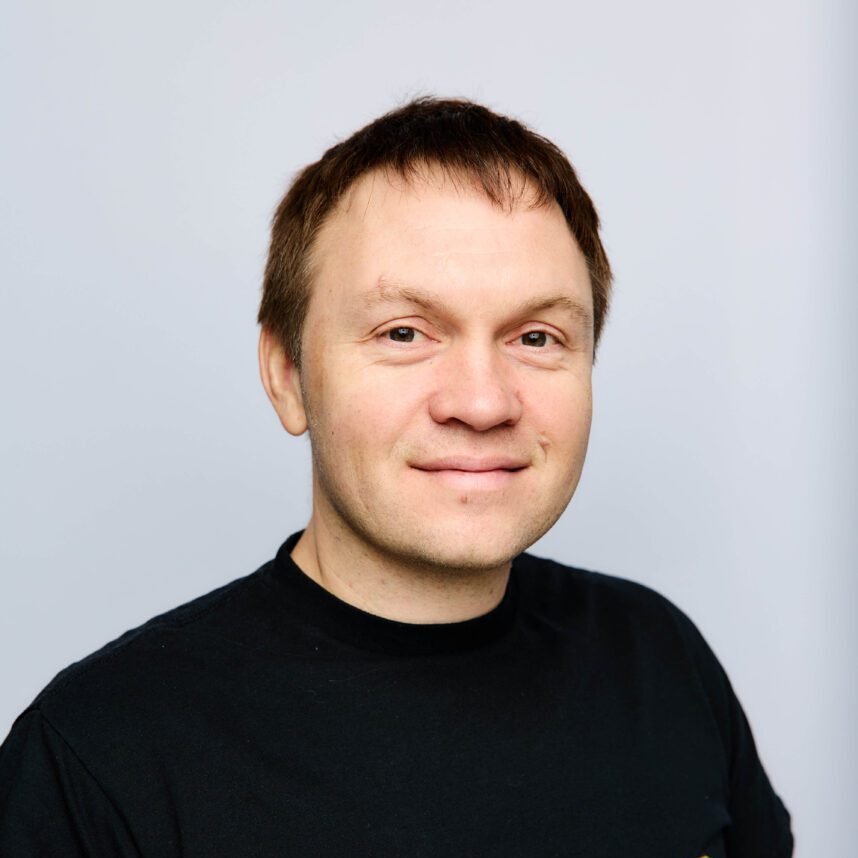
Vasili Razhnou is a serial entrepreneur, healthcare technology innovator, and Founder & CEO of MEDvidi, an AI-powered virtual mental healthcare company transforming how psychiatric care is delivered in the United States.
With over 15 years of experience in healthcare operations and five startups under his belt, Vasili has dedicated his career to making healthcare more accessible, affordable, and efficient through technology.
Under his leadership, MEDvidi has become a profitable, rapidly growing healthcare company focused on expanding access to high-quality mental healthcare through technology, operational innovation, and artificial intelligence.
Vasili is particularly passionate about the intersection of artificial intelligence and clinical care. His vision is to move beyond AI as an administrative tool and develop clinically validated AI systems that can safely support medical decision-making, improve patient outcomes, and dramatically expand access to care.
An alumnus of Stanford Graduate School of Business’s Executive Program, Vasili combines entrepreneurial ambition with a practical, data-driven approach to leadership. He believes the greatest opportunities in healthcare come from challenging traditional models, simplifying complex systems, and building technology that delivers measurable value to patients and providers.
Company: MEDvidi
We are thrilled to have you join us today, welcome to ValiantCEO Magazine’s exclusive interview! Let’s start off with a little introduction. Tell our readers a bit about yourself and your company.
Vasili Razhnou: Thank you for having me! I’m Vasili Razhnou, Founder and CEO of MEDvidi, an AI-powered virtual mental healthcare company focused on making psychiatric care more accessible, affordable, and efficient.
I’ve spent over 15 years in healthcare and have built five startups along the way. My entrepreneurial journey started with traditional healthcare operations, where I experienced firsthand how inefficient and fragmented the system can be. That experience shaped my belief that technology, and especially artificial intelligence, can fundamentally change how healthcare is delivered.
At MEDvidi, we’re building more than a telehealth platform. We’re rethinking how psychiatric care should work by integrating AI into clinical workflows, reducing administrative burdens on providers, improving patient experiences, and developing systems that support safer and more efficient medical decision-making.
We’ve built a profitable, rapidly growing company, but what excites me most is the opportunity ahead. I believe AI will fundamentally transform healthcare, not by replacing doctors, but by allowing them to focus on what matters most: their patients.
My personal philosophy is simple: challenge conventional thinking, continuously learn, and never stop looking for ways to make complex things simpler and better.
What was the moment you realized that complexity was holding your company back, and how did that shift your approach to product, operations, or strategy?
Vasili Razhnou: One of the biggest turning points came when I realized that growing a healthcare company doesn’t necessarily mean making it more efficient. As MEDvidi scaled, we were adding more people, processes, and management layers to handle increasing patient demand. Revenue was growing, but operational complexity was growing alongside it.
We were solving problems by adding resources instead of questioning why those problems existed in the first place.
That realization fundamentally changed my approach. Instead of asking how many people we needed to support the next stage of growth, I started asking which processes we could eliminate, simplify, or automate entirely.
We began systematically examining our operations, from patient intake and scheduling to clinical documentation, quality assurance, and patient support. We introduced AI automation, redesigned workflows, and challenged processes that had become unnecessarily complicated.
The results were significant. We reduced administrative workloads, improved operational efficiency, and created the foundation for scaling without proportionally increasing costs.
The biggest lesson for me was that complexity often hides behind growth. It’s easy to mistake a larger organization for a stronger one. Today, I believe the best way to scale is not to build more processes, but to continuously eliminate unnecessary ones.
Simplicity isn’t just about making things easier. It’s a competitive advantage that allows companies to move faster, operate more efficiently, and deliver a better experience to customers.
Can you share one specific example of something you simplified (a product feature, process, pricing model, or customer experience) that delivered outsized results?
Vasili Razhnou: One of the best examples is how we transformed clinical documentation at MEDvidi.
Traditionally, psychiatric providers spend a significant amount of time documenting patient visits. After each appointment, they need to prepare clinical notes, review patient histories, and ensure documentation meets quality and compliance standards. It’s essential work, but much of it is repetitive and takes valuable time away from patient care.
We asked a simple question: Why should highly trained medical professionals spend so much time manually documenting information that technology can organize for them?
We developed an AI-powered clinical documentation system that automatically generates structured clinical notes based on patient encounters. Instead of starting from scratch, providers review, adjust, and approve the documentation.
The impact was substantial. We reduced documentation time from approximately 15 minutes to 5 minutes per visit, saving providers hours of administrative work every week.
We also introduced AI-powered chart reviews, allowing us to evaluate virtually every clinical record for quality and compliance instead of relying on a small sample of manual audits.
What makes this example particularly meaningful is that we didn’t just make an existing process faster. We fundamentally redesigned it.
The lesson is that the biggest improvements often come from questioning whether a task needs to be performed the traditional way at all.
For me, that’s the essence of simplicity: removing unnecessary work while improving quality, safety, and the experience for both patients and providers.
How do you systematically identify and eliminate complexity across the organization without oversimplifying in ways that hurt quality or value?
Vasili Razhnou: I believe the key is understanding the difference between necessary and unnecessary complexity. In healthcare, some complexity exists for a very good reason, particularly when it comes to patient safety, clinical quality, and regulatory compliance. The goal isn’t to eliminate complexity at any cost. It’s to remove everything that doesn’t create meaningful value.
At MEDvidi, we approach this systematically through data, automation, and continuous process improvement.
First, we measure everything. We look at how much time processes consume, where bottlenecks occur, how often errors happen, and what impact each activity has on patients and providers. If a process requires significant resources but delivers limited value, it’s a candidate for redesign.
Second, we challenge assumptions. Just because something has always been done a certain way doesn’t mean it’s the best approach. I encourage our teams to question existing workflows and look for opportunities to eliminate steps rather than simply optimize them.
Third, we use AI strategically. We automate repetitive administrative tasks while maintaining human oversight where clinical judgment is essential. For example, AI can generate documentation, identify potential compliance issues, and flag clinical risks, but licensed providers remain responsible for medical decisions.
Finally, we measure outcomes after every significant change. Efficiency alone isn’t success. If a process becomes faster but quality declines, we haven’t actually improved anything.
One principle I consistently reinforce is that we should simplify the process, not compromise the standard.
The ultimate goal is to build an organization where technology handles unnecessary complexity behind the scenes, allowing our people to focus on the work that truly matters. In healthcare, that means better patient care, stronger clinical outcomes, and a more sustainable business.
What’s the biggest resistance you’ve faced when pushing for radical simplicity, and how did you overcome it?
Vasili Razhnou: The biggest resistance I’ve encountered is the belief that complexity equals sophistication, especially in healthcare.
People often assume that more processes, more approvals, and more layers of management automatically mean better quality and stronger control. In a highly regulated industry, this mindset is particularly common because everyone is understandably concerned about making mistakes.
When we started introducing AI into clinical and operational workflows at MEDvidi, there was natural skepticism. Some people worried about accuracy, others about compliance, and some simply felt more comfortable with familiar processes.
I learned that you can’t overcome this resistance by simply telling people that a new approach is better. You have to demonstrate it.
We started with specific, measurable problems, introduced automation gradually, and compared results against existing processes. When our teams saw that AI could reduce administrative work while maintaining or improving quality, attitudes began to change.
Another important lesson was to involve the people closest to the work. They often understand the unnecessary complexity better than leadership does. Instead of imposing solutions from the top, we encouraged teams to identify inefficiencies and participate in redesigning their own workflows.
I also realized that simplicity requires strong leadership discipline. As companies grow, complexity naturally returns. Every department wants additional resources, new procedures, and more controls. Leadership has to continuously challenge whether those additions are truly necessary.
Today, I try to build a culture where questioning existing processes is encouraged, experimentation is supported, and decisions are driven by measurable outcomes rather than hierarchy or tradition.
The biggest shift happens when people stop seeing simplicity as cutting corners and start recognizing it as a way to achieve better results with less unnecessary effort.
For other CEOs who struggle with feature bloat, process overload, or confusing customer journeys, what’s the most important principle or first step you would recommend they take?
Vasili Razhnou: My advice is to start by questioning everything you’ve built, including the processes and features that once made your company successful.
One of the biggest mistakes CEOs make is assuming that because something was necessary at an earlier stage, it must remain necessary as the company grows. Over time, organizations accumulate processes, features, approval layers, and responsibilities that nobody challenges anymore.
I would recommend starting with one simple question: If we were building this company from scratch today, would we design it the same way?
At MEDvidi, this question has helped us rethink everything from patient onboarding to clinical documentation and internal operations.
The next step is to identify where complexity creates the most friction. Look at where customers get confused, where employees spend time on repetitive tasks, and where decisions take unnecessarily long. Don’t try to simplify everything simultaneously. Pick one high-impact area, redesign it, measure the results, and expand from there.
Another principle I strongly believe in is that automation should come after simplification. Too many companies use technology to automate inefficient processes without questioning whether those processes should exist at all. That often makes complexity faster rather than eliminating it.
Finally, CEOs need to recognize that simplicity is not a one-time initiative. It’s a leadership discipline. As organizations grow, complexity naturally accumulates, so you need a culture that continuously challenges the status quo.
My guiding principle is simple: Don’t optimize what you can eliminate, and don’t automate what you haven’t simplified.
The companies that win in the long run aren’t necessarily those with the most features, people, or processes. They’re the ones that consistently deliver the greatest value with the least unnecessary complexity.