



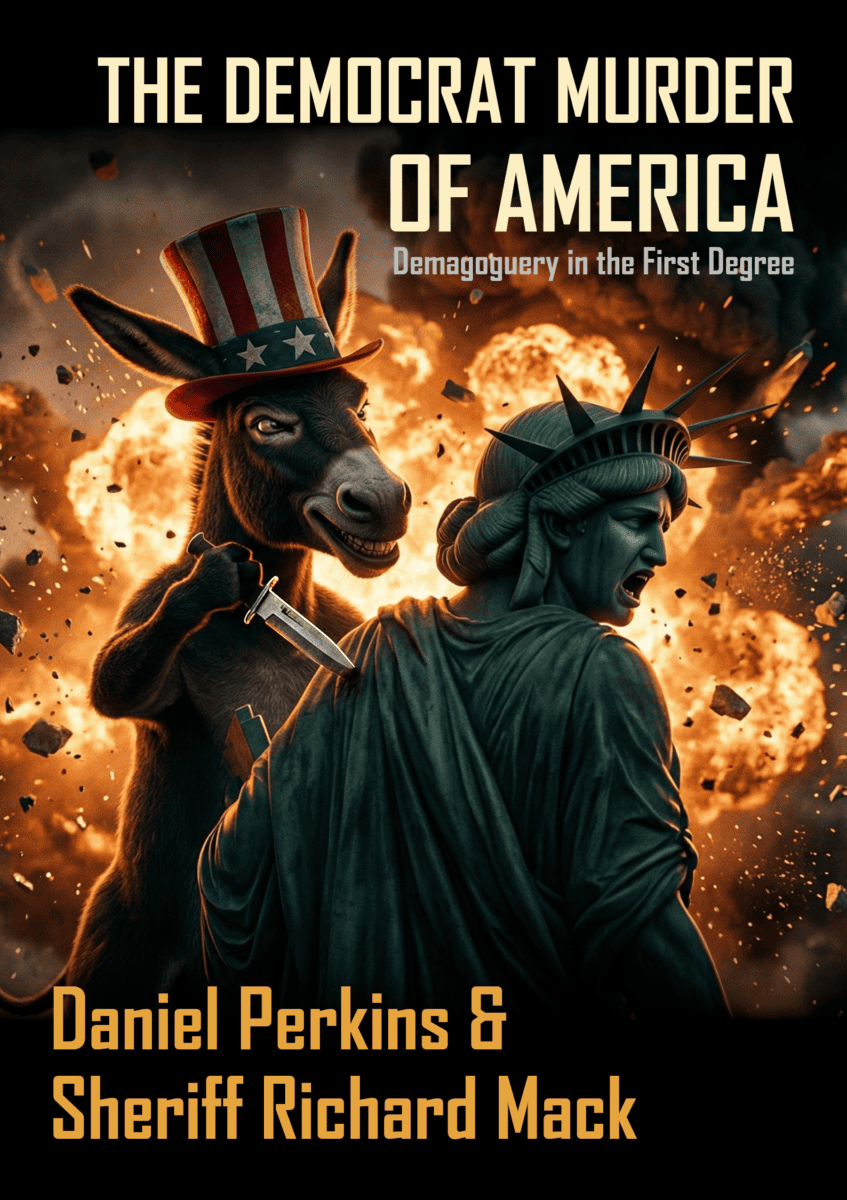
Political history can raise difficult questions about how Americans understand the parties they support and the government they expect to protect their rights. Those questions provide the starting point for Sheriff Mack’s account of the country’s political development, which he approaches through his concerns about constitutional limits, partisan loyalty, and individual liberty.
In The Democrat Murder of America, subtitled Demagoguery in the First Degree, Sheriff Richard Mack and co-author Daniel Perkins examine American political history through their concerns about government corruption and civil rights. A former Arizona sheriff, Mack is also founder and president of the Constitutional Sheriffs and Peace Officers Association (CSPOA). He frames the organization’s educational work as helping sheriffs, peace officers, and the public understand civil rights and responsibilities. That interest also forms the book, which he presents as an invitation to reconsider familiar political narratives and examine the principles behind party allegiances.

Despite the title’s partisan focus, Mack explains that his intended audience includes people across political affiliations. He particularly hopes families will discuss these historical and constitutional questions together. “Parents should have their children involved in understanding the principles that we cover in this book,” he notes. His stated concern extends to the influence both major parties exercise over public life.
The collaboration began, according to Mack, after he and Perkins appeared on a podcast together. A subsequent conversation about Mack’s earlier books developed into a proposal to write together. Mack recalls organizing their ideas into chapters, then rearranging the material chronologically. That approach supports his broader interest in how earlier political conflicts connect with present debates.
Among those historical subjects are slavery, Abraham Lincoln, and civil rights. Mack emphasizes Lincoln’s Republican affiliation and argues that readers should look more closely at the parties’ earlier positions. The National Archives documents Lincoln’s insistence that the Republican platform support the Thirteenth Amendment in 1864. Ratified in December 1865, the amendment abolished slavery. At the time Democrats were opposed to abolishing slavery for over 100 years.
Mack’s concern about political allegiance also draws on George Washington. Mack identifies Washington’s warning about faction as an underlying message of the book. In his Farewell Address, Washington cautioned that partisan divisions could enable ambitious individuals to undermine the power of the people, while also emphasizing respect for constitutional government. Mack connects that warning to the political hate and violence that are so prevalent in America today.
He gives that concern a more accessible form through an analogy involving ants in a shaken jar. As Mack uses the image, the ants represent people drawn into conflict while overlooking the source of the disturbance. He presents it as a metaphor for political division, inviting readers to consider who benefits when public attention remains fixed on hostility between opposing groups.
The book’s discussion of socialism and communism follows from Mack’s concern about expanding government authority. He examines some contemporary political developments through that ideological lens. These connections form part of his political argument and require evaluation of their supporting evidence. His discussion of enforcement involving Amish farmers similarly expresses his concern about the effects government action can have on individuals and their livelihoods. Mack states, “The catastrophic result of such is that innocent people end up as victims of an out of control government bureaucracy.”
That concern leads to his belief that local sheriffs have a significant responsibility to protect constitutional rights. His own litigation provides a documented connection. In the 1997 case Printz v. United States, which included Mack’s challenge, the Supreme Court invalidated federal requirements compelling local Sheriffs to conduct interim handgun background checks. The ruling addressed limits on federal direction of state officers. He states “ It’s every law enforcement officer’s responsibility to protect against all enemies, both foreign and domestic”. This ideology he believes is imperative given his research where he recognized a quote given by Martin Luther King Jr., “One has not only a legal but moral responsibility to obey just laws. Conversely, one has a moral and lawful responsibility to disobey unjust laws”. Mack states, “Likewise, no sheriff has a duty to enforce unjust laws, in fact, quite the contrary.”
“I love the constitutional government that was established,” Mack explains. “What I hate is a corrupt government.” That distinction brings together the book’s historical interests and his concern about accountability. For readers, the invitation is to examine the events he selects, compare his historical evaluations with public records, and consider how constitutional protections are being destroyed by corrupt politicians.
His broader question concerns the responsibilities every American carries when political loyalty and the exercise of government power come under scrutiny. He asks every reader, “Is there a political evil out there that is steadily leading America to communism? This is the year that Americans will decide; freedom or communism, you can’t have both.”