




SALT and CoinRabbit represent two distinct schools of thought in crypto-backed lending. SALT, one of the industry’s earliest lenders, is built around fixed terms, a defined collateral list, and a formal underwriting process. CoinRabbit takes a more flexible route, with a choice of open-ended or fixed-term loans, high LTV, minimal onboarding, and support for a far wider range of tokens. Neither approach is inherently better; they simply serve different borrowers.
For anyone whose goal is liquidity without triggering a taxable sale, a crypto loan solves the core problem. The question this comparison answers is which structure fits the way you actually borrow.
SALT vs CoinRabbit: Platform Overviews
SALT, short for Secured Automated Lending Technology, was founded in Denver in 2016 and is among the longest-running centralized crypto lenders, having operated through several full market cycles. Borrowers take loans in USD or stablecoins against BTC, ETH, USDC, USDT, and the platform’s own SALT token. The product centers on fixed terms and a stabilization mechanism designed to protect positions during sharp drawdowns.

CoinRabbit launched in 2020 as a multi-asset platform built around fast access to liquidity. It keeps 100% reserves, with pledged assets held in segregated cold multisig wallets, and pairs lending with token swaps, a wallet, and yield options, so borrowing sits inside a broader toolkit rather than standing alone.
Crypto Loan Products and Terms
SALT offers LTV ratios of 30%, 50%, or 70%, with APRs running from 7.49% to 10.50%, tiered by LTV band and term length. Loans are fixed-term, with a choice of one, three, or five years, and a choice of interest-only payments, principal and interest, or accrued interest paid at maturity. Full KYC is required, the loan minimum is $5,000, and collateral is limited to BTC, ETH, USDC, USDT, and SALT.
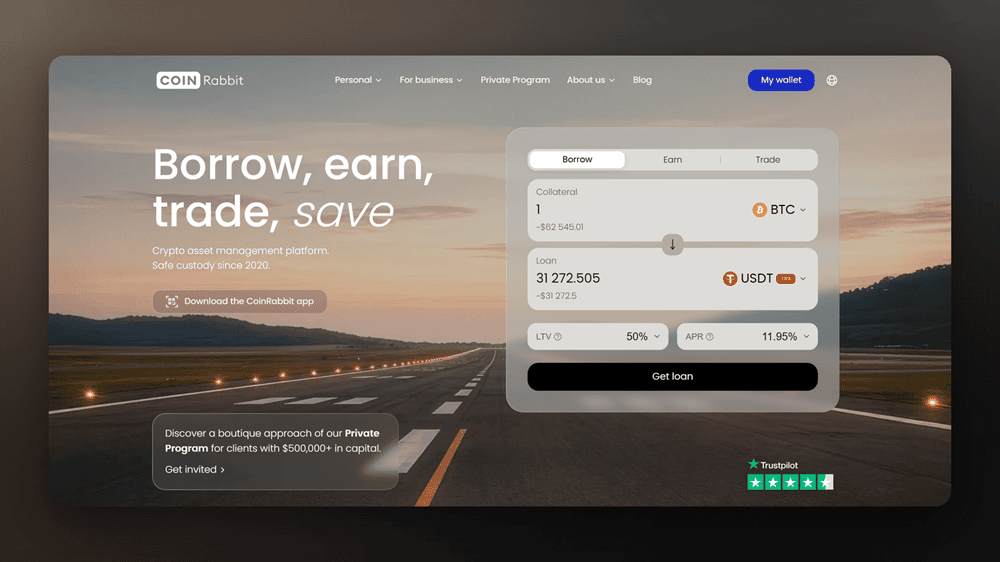
CoinRabbit extends LTV up to 90%, which frees more cash per unit of collateral at the cost of a thinner margin buffer. APR starts at 11.95% and stays fixed for the full life of the loan. Borrowers also set the liquidation threshold at origination: a standard 80% liquidation LTV, or a 90–95% option that pushes liquidation further out.
Loans come in two structures. Open-ended loans carry no fixed maturity, so a position can stay open as long as collateral coverage holds. Fixed-term loans run on a set repayment period, typically 30 days, with interest calculated upfront at a lower rate and no penalty for early repayment. CoinRabbit supports over 400 cryptocurrencies across the platform, with a collateral list that runs far beyond BTC and ETH.
Read side by side, the difference is one of range. SALT prices predictability into a single fixed schedule. CoinRabbit lets the borrower choose between a fixed term and an open-ended position, and pairs that with higher available leverage.
SALT vs CoinRabbit: Collateral Management and Custody
Custody is where the two platforms diverge most sharply, and it deserves attention from any borrower comparing them.
SALT operates centralized custody with active risk monitoring through its custodian subsidiary. Under its Terms of Use, collateral is held off the custodian’s balance sheet and is not subject to the claims of the custodian’s creditors. The same document states that the lender retains the right to repledge, sell, transfer, or otherwise use pledged collateral as provided in the loan agreement. The platform pairs this with a stabilization mechanism that can convert collateral to USDC during significant market drops, a feature intended to help borrowers avoid outright liquidation.
CoinRabbit stores collateral in segregated cold multisig wallets and does not reuse or lend out pledged assets. Its no-rehypothecation policy means collateral is never put to work elsewhere, which reduces counterparty risk for the borrower.
SALT vs CoinRabbit: Comparison Table
| Feature | SALT | CoinRabbit |
| Founded | 2016 | 2020 |
| Collateral assets | BTC, ETH, USDC, USDT, SALT | 350+ |
| LTV | 30% / 50% / 70% | 50-90% |
| APR | From 7.49% (tiered by LTV and term) | From 11.95% (fixed) |
| Loan term | Fixed: 1, 3, or 5 years | Open-ended or fixed-term |
| Rehypothecation | Permitted under loan agreement | None |
| KYC | Full KYC | Minimal |
| Minimum loan | $5,000 | $30 |
| Funding speed | 24-48 hours | ~10 minutes |
| Support | 24/7 AI chat; human Mon-Fri | 24/7 human |
Fees and Cost Structure
SALT’s tiered structure rewards conservative borrowing: lower LTV bands and shorter terms sit at the cheaper end of its 7.49% to 10.50% range, and the fixed schedule supports predictable budgeting. SALT charges no origination, prepayment, custody, or withdrawal fees. Several conditional fees apply only to specific choices: a 1.5% processing fee on crypto payments outside Auto-Pay, a 3% fee if Stabilization is selected, a 2% conversion fee after Stabilization, and a 5% liquidation fee. The trade-offs are attention to repayment timing at maturity, full KYC, and the rehypothecation terms noted above.
CoinRabbit charges an origination fee made up of a network fee and a service fee. It accrues no interest and is added to the repayment amount rather than deducted from the disbursement, and it is shown before the loan is confirmed. Beyond that, total cost is driven by the LTV selected and the asset pledged, with the 11.95% starting APR applying to payouts into the CoinRabbit Wallet. The absence of mandatory interim payments suits long-duration holders, though higher leverage raises liquidation exposure in a sustained downturn.
Supported Assets and Features
SALT works with a focused, familiar collateral list and fixed schedules, plus its stabilization tool for managing sharp downturns. It fits borrowers who want a defined repayment plan and are comfortable with a smaller asset set.
CoinRabbit accepts 350+ assets as collateral and layers on automated top-ups, real-time health monitoring, and risk-zone alerts by email or SMS. For holders of altcoins or mid-cap tokens, that removes the need to rotate into blue chips before borrowing.
Borrowing Experience
SALT runs application-based onboarding with full KYC, and funding typically lands within 24-48 hours, which positions it toward borrowers comfortable with a formal, bank-like process.
CoinRabbit typically completes a loan in about 10 minutes, with entry as low as $30 and 24/7 human support, which makes it practical when funding is time-sensitive or the amount is small.
Programs for Larger Clients
Both platforms run dedicated tracks for larger borrowers, though they define the tier differently.
SALT’s Private Clients program targets sophisticated investors and does not publish an entry threshold. It centers on tailored lending terms, personalized borrowing strategies, and a dedicated relationship manager who serves as a single point of contact.
CoinRabbit sets the bar explicitly at $500,000 in capital. Its Private Program adds a dedicated success manager, customized terms, cross-collateralization, OTC services, and direct bank transfers, aimed at high-net-worth users, family offices, and institutions that want tailored handling rather than a standard loan flow.
Which One Fits You: SALT or CoinRabbit
SALT suits borrowers who want a fixed schedule of one, three, or five years, published tiered rates, and a built-in stabilization feature, and who are comfortable with full KYC, a defined collateral list, and the platform’s rehypothecation terms.
CoinRabbit is the better fit for holders who want higher LTV, a choice between fixed-term and open-ended structures, a wide range of accepted tokens, fast funding at low minimums, and segregated custody with no rehypothecation.
SALT vs CoinRabbit: Final Verdict
Both platforms answer the same question, how to raise liquidity without selling, with different architecture. SALT offers a structured, fixed-term route with tiered pricing and a stabilization mechanism, backed by nearly a decade of operating history. CoinRabbit builds for flexibility: both open-ended and fixed-term loans, up to 90% LTV, 350+ assets accepted as collateral, and segregated custody that never reuses collateral, delivered with fast funding and 24/7 support. The deciding factor is not which platform is stronger, but which structure matches your horizon, your collateral, and your tolerance for the trade-offs each design carries.
As with any loan against volatile collateral, outcomes depend on market swings and the LTV you choose. Terms change; confirm the latest figures with each platform before borrowing.

