
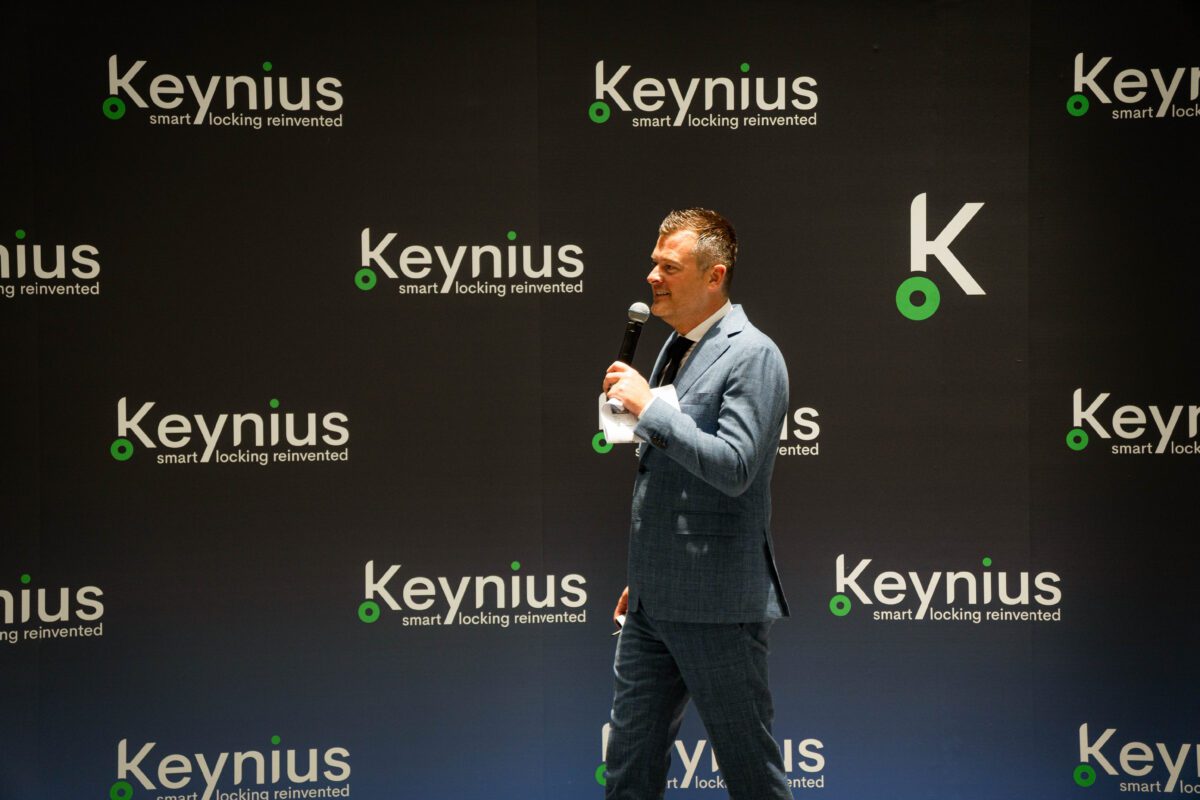
René de Bruin is Co-Founder and Chief Commercial Officer of Keynius, a smart locker technology company based in the Netherlands, and former Co-Founder and CEO of Olssen.
With over 20 years’ experience in the locker industry, he helped grow a family business selling second-hand lockers into a business combining lockers, hardware, and software.
Today, he leads Keynius’ commercial growth and international partnerships, taking a customer-first approach to making storage simpler for workplaces, hospitality and public venues.
Company: Keynius
We are thrilled to have you join us today, welcome to ValiantCEO Magazine’s exclusive interview! Let’s start off with a little introduction. Tell our readers a bit about yourself and your company.
René de Bruin: I’m René de Bruin, Co-Founder and Chief Commercial Officer of Keynius. I’ve worked in the locker industry since 2004, starting with a family business selling second-hand lockers. Over time, our conversations with customers shifted from the locker itself to how people access storage and how organisations manage it. That helped shape the business we have today.
Based in the Netherlands, Keynius is a smart locker technology company bringing together lockers, hardware, and software for workplaces, hospitality and public venues. We help organisations move beyond keys and manual administration, making storage easier to use and manage.
My role focuses on commercial growth and international partnerships, but it still starts with listening to customers. I believe technology should make their day simpler. Understanding the problem comes first, and choosing the technology comes after.
What was the moment you realized that complexity was holding your company back, and how did that shift your approach to product, operations, or strategy?
René de Bruin: The realisation came through listening to customers. We could talk about locks, access methods, and software features, but their questions were often much more practical. How does someone store their belongings? How does the organisation manage access? What happens when something goes wrong?
That changed how we approached the product. We needed to start with the customer’s workflow rather than expect them to adapt to ours. An office, a pharmacy, a museum, and a concert venue may all need lockers, but the people using them have very different needs and demands.
Our focus became making the technology adaptable while keeping the experience straightforward. We ask what the user needs to do, what the operator needs to control, and which steps we can remove. That also gives us a clearer way to explain the product, as we can show how it solves the customer’s problem before discussing the technology behind it.
We also keep close relationships with our clients, often building custom features for them after the install, so we can ensure that we’re also solving their unforeseen problems.
For me, simplicity means doing the difficult thinking ourselves so the customer doesn’t have to.
Can you share one specific example of something you simplified (a product feature, process, pricing model, or customer experience) that delivered outsized results?
René de Bruin: A good example is the locker experience at AFAS Live, a concert venue in Amsterdam. The lockers are the easy part, because visitors need somewhere to leave their belongings, and smart lockers don’t create long queues like a coatcheck line does. But for the venue, the challenge is managing what happens when they open the doors and thousands of people enter all at once.
To help manage this, we built a few features for AFAS Live:
First, the ability for the venue to create an event schedule in the Keynius Portal, so guests can pre-rent a locker.
Second, placing QR codes outside the venue so people can rent a locker while they’re waiting in line before the show. These QR codes spread out the crowd, so not everyone is flocking to the exact same locker wall.
And third, we created geo-based QR codes inside the venue, so that when a guest scans a QR code they’re assigned to the nearest available locker.
We also made sure our entire booking system was lightweight and could run from a mobile browser, to avoid unnecessary app downloads, and that guests could share a locker via email or WhatsApp in one click.
So when I think about simplification, I try to find the step that creates friction for several people, and solve it at the source.
How do you systematically identify and eliminate complexity across the organization without oversimplifying in ways that hurt quality or value?
René de Bruin: I start by separating necessary complexity from unnecessary effort. Security, reliability, and access control can require sophisticated technology. The goal is to make that technology manageable, not remove the safeguards that make it valuable.
The questions I always come back to are:
Who needs this step?
What problem does it solve?
Are we asking the customer to do something the system could handle?
If we remove it, what might break?
It also matters whose experience we are trying to simplify. One-time users at an event need a simple, fast solution. But a a facilities manager administering hundreds of lockers needs a clear and secure solution that they can implement effectively. Giving everyone the same interface or process can create more work, even if it sounds simpler.
The same principles apply internally. It’s about finding the right process, not the shortest or fastest process. Do your due diligence, communicate with the client, listen, be receptive, and look for solutions.
My test is whether we have reduced the total effort involved while protecting the outcome. Fewer clicks, fewer features, or fewer steps are only useful if people can still do the job properly. Always solve the actual problem.
What’s the biggest resistance you’ve faced when pushing for radical simplicity, and how did you overcome it?
René de Bruin: The biggest challenge is the concern that simplifying something means taking away capability. When customers have different requirements, it is understandable to want more options, more controls, and more exceptions. Each addition can make sense individually, but together they can make a system harder to use and support.
And for a while, we were guilty of trying to satisfy every single customer “want”, instead of focusing on the customer “need”. And it may sound simple, but repeatedly asking “why” can be an extremely powerful way of getting to the root of what the client actually needs, because it forces them – and me – to think about what’s truly happening and causing friction.
My approach is to bring the discussion back to the job the customer needs to do. So whether it’s a workplace needing de-anonymized login access, a pharmacy needing to automat prescription collections, or a hotel giving early check-in or late check-out guests a secure place to store their luggage, we try to preserve the capability each situation requires without making everyone navigate every possible option.
We still run into trying to satisfy our customer’s “wants”. Every new request creates another decision. The muscle we’re trying to build and instill is to keep listening, understand the underlying need, and avoid making the experience more complicated than that need requires.
For other CEOs who struggle with feature bloat, process overload, or confusing customer journeys, what’s the most important principle or first step you would recommend they take?
René de Bruin: Start by watching someone use what you have built, without explaining it to them. What is self-explanatory, what causes friction, and what needs a workaround? Those moments tell you more than a discussion about which features to add next.
Then ask yourself “what is this person actually trying to accomplish?” For us, the decision-makers make their choices based on things like integrations, security, permissions, rules, processes, and so much more. But the average user just wants a quick and easy way to access a locker, period. So both are important to ensure adoption, but you can’t have one without the other.
So first and foremost, make sure your basic offering is easy to use. If it’s not, everything else you add on top of it isn’t solving the core problem of making the customer’s task easier, not just your product’s feature list shorter. If you keep that outcome in view, it becomes much easier to decide what to keep, what to change, and what to leave out.