



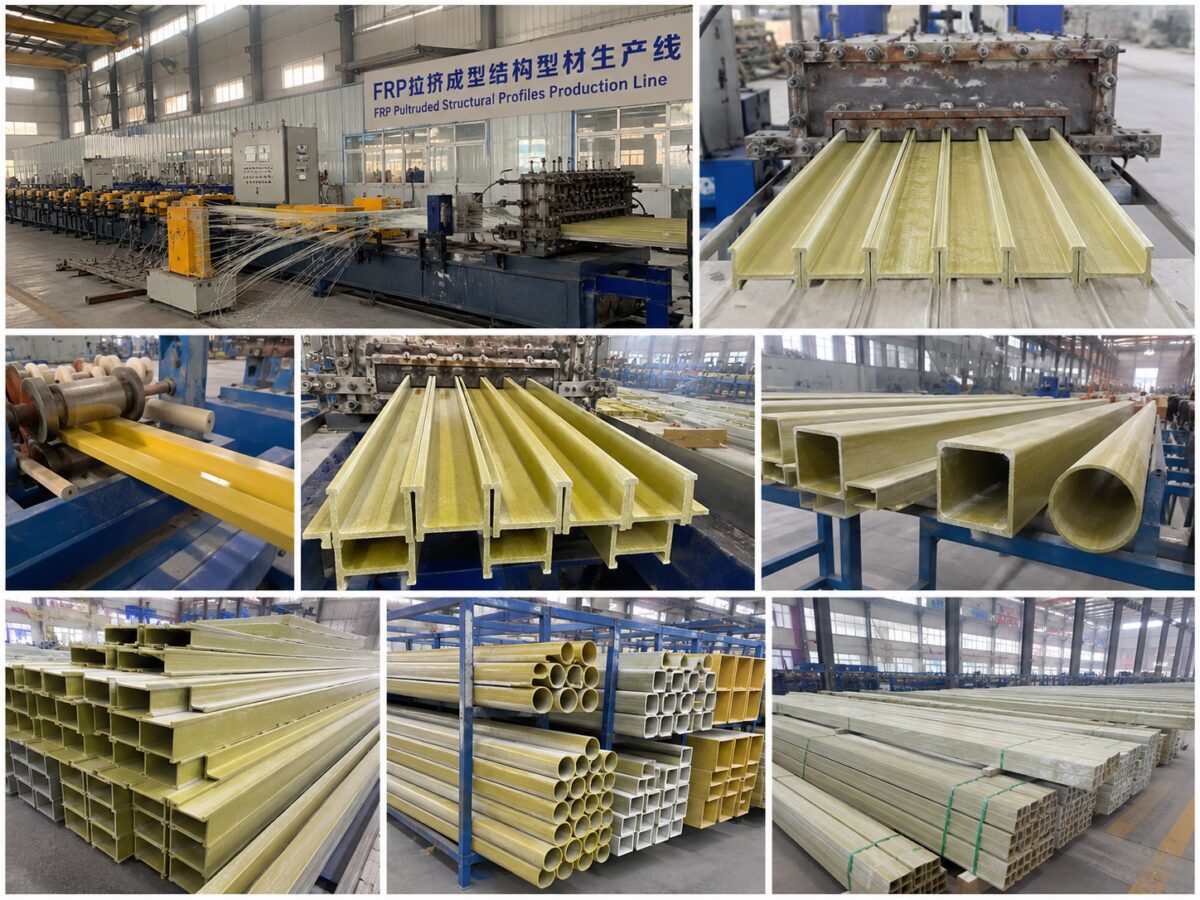
Stable support structures are essential for industrial equipment, as they must support the load, exposure to the environment, and the routine maintenance requirements of the equipment. Choosing the appropriate framing materials can influence efficiency of installation, structural performance, and long-term maintenance. For applications where corrosion, weight, or electrical conductivity are factors in material selection, fiberglass-reinforced plastic is an alternative to conventional metals. Pultruded profiles are used to produce frames for building equipment, assemblies for mounting equipment, and support for auxiliary equipment parts, ensuring consistent shapes. Knowledge of their actual applications enables engineers to select the correct sections, estimate connection needs, and plan support systems with regard to actual operating conditions.
1. Supporting Equipment in Corrosive Industrial Environments
In industrial applications, equipment frames are often exposed to moisture, chemical splash, cleaning solutions, and corrosive environments. Corrosion can be a concern with conventional steel structures, and they will need protective coatings as well as periodic inspections. There are also limitations under particular chemical conditions with stainless steel and aluminum. When their resin systems are appropriate for the environment, FRP profiles can offer an alternative.
They are used to mount pumps, instrument panels, chemical dosing devices, and auxiliary assemblies. Their effectiveness is dependent upon chemical medium, concentration, temperature, and duration of exposure. Structural loads and connection details must be considered first by the engineer before a profile is selected. Use of suitable material specifications will ensure adequate support of the equipment but will not assume universal chemical resistance.
2. Building Lightweight Frames for Mechanical Equipment
Equipment support frames can have multiple beams, braces, mounting rails, and vertical members. These heavy structural materials can pose difficulties in transportation, handling, and installation, especially in high-rise or space-constrained areas. Compared to similar steel profiles, pultruded fiberglass profiles weigh less and can be used in specific lightweight structural assemblies.
Square tubes, rectangular tubes, channels, angles, and I-beams provide a variety of framing options. Hollow sections can be used to create posts and perimeter frames, and channels can be used to provide mounting edges and bracing arrangements. Stiffness, deflection, vibration, and load distribution are as important factors to consider for engineers as weight. Even a lighter frame needs proper anchoring, joint design, and appropriate support for the equipment that is to be used.
3. Creating Modular Frames for Equipment Installation
Modular equipment frames allow components to be assembled into easy-to-access units that can make transportation, positioning, and maintenance easier to manage. Standard profile shapes enable a designer to design repeatable layouts based on mounting points, service clearances, and equipment dimensions. When appropriate for the design, FRP pultruded profiles can be used as beams, posts, crossmembers and braces.

These assemblies can be used for control cabinets, sensor housings, small process assemblies and auxiliary electrical assemblies. Mounting holes, brackets and connection locations can be custom cut/drilled. Machining, however, should be carried out in accordance with appropriate fabrication practices and maintain the necessary edge distances. The added advantage of modular construction is the fact that there are well-defined tolerances, fastening methods, and assembly drawings prior to the manufacturing process.
4. Practical Applications of FRP Equipment Support Frames
The applicability of an FRP frame will depend on the respective equipment that is supported, the installation environment, and the needed structural performance. The various profile configurations meet different mounting and reinforcement requirements.
Common applications include:
- Pump support assemblies: Frames for selected pumps and auxiliary components in moisture-prone facilities.
- Electrical equipment racks: Structures for control panels and instrumentation where verified electrical insulation is beneficial.
- Chemical dosing systems: Supports for dosing equipment and associated components in chemically exposed areas.
- Cable and instrument supports: Frameworks for organizing auxiliary equipment, junction boxes, and selected service components.
- Ventilation equipment supports: Frames for suitable fans, duct accessories, and related components after load assessment.
Equipment weight, dynamic forces, mounting arrangements, and maintenance access must be evaluated for each application. Vibration and fatigue may be factors to consider when choosing section and joint design for rotating machinery. Thus, the frames of equipment should be based on the application-specific engineering calculation and not only on the shape of the profile.
5. Supporting Electrical and Utility Equipment
Materials with low electrical conductivity are sometimes used for electrical and utility installations. FRP may provide insulating properties over traditional conductive metal framing for specific equipment racks, instrument supports, and utility structures. But actual electrical performance will be dependent on the material formulation, reinforcement, moisture exposure, contamination, and assembly details. The designer should check the dielectric characteristics and safety requirements before using FRP in the vicinity of electrical systems. The frame should also be rigid enough to ensure the safety of mounted equipment and clearances. Fasteners, brackets, and neighbouring components must be considered separately, as metal hardware can create conductive paths. FRP should not be used as a substitute for grounding, isolation, or other protective measures necessary for electrical codes.
6. Selecting Suitable Profiles and Resin Systems
The first step in profile selection is the frame geometry, the anticipated loading, the installation space, and the environmental conditions. Square and rectangular tubes are ideal for a variety of post and perimeter-frame designs, while channels and angles are used for edges, bracing and mounting work. Beam sections may be appropriate for longer spans, provided the stiffness and strength of the beam are adequate for the span being calculated.
The choice of resin is also critical. Polyester formulations might be appropriate for some general service applications, and isophthalic polyester or vinyl ester might be used for specific chemical exposure applications. The compatibility needs to be checked with the precise medium and running temperature. Where applicable, engineers should also consider UV exposure, fire resistance, creep, and deflection. Selection based on manufacturer test data and/or project-specific calculations is more sound than using a generic material description.
7. Fabrication, Connections, and Installation Considerations
Choosing a good frame for equipment is more than just a profile selection. Lengths, hole sizes, joint geometry, and fastening arrangements shall be in accordance with the approved design. Pultruded members can be joined with mechanical fasteners and brackets, with bearing stresses, edge distances, and local reinforcement needs to be checked by the engineer. Adhesive bonding can also be used when the design of the joint and the service conditions are conducive.
Manufacturing drawings should contain dimensions, tolerances, location of connections, and the sequence of assembly. Handling, anchoring, alignment, and maintenance access should be considered when planning installation. Hebei Leihong FRP Technology Co., Ltd. provides standard and customized FRP profile manufacturing; the requirements of the project are the basis for material selection and manufacturing details. This will help minimize unnecessary fit-up issues if the specifications are verified prior to production.
8. Evaluating Long-Term Performance and Maintenance
Although FRP equipment support frames can diminish some of the maintenance requirements associated with corrosion, they must be routinely inspected. Operators should check surfaces for cracks, impact damage, exposed fibers, abnormal deformation, and deterioration around drilled holes. Fastener connections require special attention as loosening of fasteners, damage to bearings, or improper hardware may impact stability.
When installing outdoors, one must take into account exposure to UV, weathering, and temperature fluctuations. Inspection periods for frames used for vibrating machinery should be determined according to the loading conditions. Designers also need to consider the creep that will occur in the structure under permanent loads and ensure that the deflection is acceptable for the design life. Maintenance planning should be based on the material specifications, equipment requirements, and observed operating conditions.
Conclusion
FRP pultruded profiles offer functional solutions for equipment support frames when corrosion resistance, reduced handling weight, or electrical insulation is a factor in an industrial setting. They are used for pump supports, modular racks, utility structures, and auxiliary equipment assemblies.
The key to successful implementation is proper profile geometry, resin compatibility, structural calculations, and well-designed connections. A review of operating conditions and fabrication requirements prior to installation is useful in helping to develop a support system appropriate for its intended service. If properly engineered and maintained, FRP frames can be valuable alternatives to traditional materials for a limited number of industrial applications.

