



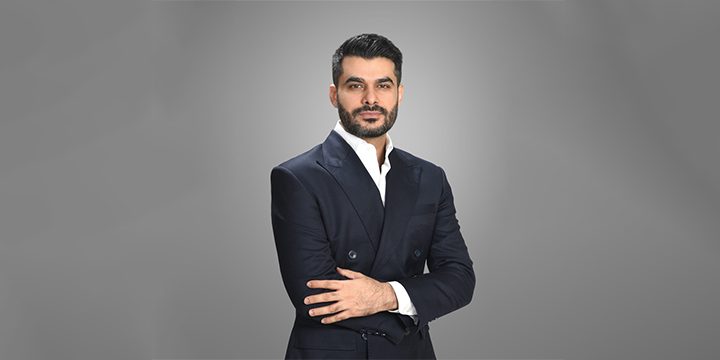
Mubashir Hanif is the Founder and Chief Executive Officer of TechMatter, a global technology company headquartered in California with operations across the US, UK, UAE, and South Asia. Since founding TechMatter in 2017, he has transformed it from a small team of 10 into a 500+ member enterprise delivering innovative healthcare and managed IT solutions worldwide. Under his leadership, the company has earned recognition for combining cutting-edge technology with strategic operational support, specializing in Revenue Cycle Management, Medical Billing, Credentialing, Telehealth Support, and managed IT services.
Mubashir is a Chartered Certified Accountant (ACCA) who blends financial expertise with a visionary approach, investing early in emerging technologies such as adaptive AI, EHR platforms, and practice management systems. His leadership is rooted in fairness, empowerment, and sustainable growth, with a focus on creating measurable value for clients. He is passionate about making advanced healthcare technology accessible and impactful for providers globally.
Company: TechMatter
We are thrilled to have you join us today, welcome to ValiantCEO Magazine’s exclusive interview! Let’s start off with a little introduction. Tell our readers a bit about yourself and your company.
Mubashir Hanif: Some entrepreneurs build companies. Others build movements. For me, TechMatter is both.
I’m Mubashir Hanif, Founder and CEO of TechMatter. My path to health tech leadership began in 2009, not in a plush office, but in a small Canadian BPO, selling calling cards one conversation at a time. Those early days were my training ground in grit, persuasion, and relentless follow-through. Coupled with my Chartered Certified Accountant (ACCA) qualification, they gave me a rare combination of commercial instinct and financial precision, the foundation I needed to scale ideas into impact.
I started TechMatter back in 2017. The idea stemmed from the conviction that healthcare deserved more than incremental change. It needed re-engineering. Today, we deliver fully integrated solutions, from proprietary EHR and practice management systems to AI-powered revenue cycle management and managed IT solutions.
What sets us apart isn’t just technology. It’s the way we think. We anticipate disruption, we design for resilience, and we lead with a “give to get” culture that empowers both our team and our clients.
What specific areas of your business have been most impacted by AI, and how?
Mubashir Hanif: Quite frankly, every area of TechMatter has been touched and transformed by AI. It’s not a tool we use in pockets of the business; it’s the backbone of how we operate.
On the client-facing side, our proprietary medical billing software is where AI’s impact is most visible. Intelligent scribing captures and structures patient encounters in real time, automated clinical notes eliminate hours of administrative work, and decision-support systems flag potential errors or compliance risks before they ever reach a payer. Virtual assistance tools guide teams through complex workflows, making sure claims are clean, timely, and optimized for maximum reimbursement.
Internally, AI powers our analytics and operational decision-making. From predicting claim denial patterns to forecasting cash flow, we use machine learning to anticipate challenges rather than react to them. AI-driven insights inform everything, from staffing allocation to process refinement, even client onboarding, enabling us to make high-impact decisions.
Even our communication channels have evolved. AI helps personalize client updates, track sentiment, and ensure that every interaction is timely, relevant, and transparent. It also supports employee training by offering adaptive learning modules that build skills in real time based on performance.
In short, AI is not an add-on at TechMatter. It’s embedded into the DNA of our operations. It has elevated accuracy, accelerated workflows, and given us the agility to stay ahead in an industry where the margin for error is shrinking and the demand for efficiency is relentless.
How are you ensuring ethical considerations are taken into account in your use of AI?
Mubashir Hanif: For us, AI is only as powerful as it is ethical. At TechMatter, we view ethics not as a compliance checkbox, but as a core design principle.
We start with patient privacy. Our systems are fully aligned with HIPAA and other global data protection regulations. Every AI model we deploy operates within secure, encrypted environments, with strict access controls to ensure sensitive information is never exposed or misused.
Transparency is another non-negotiable. We make it clear to clients how AI is being applied, what data it uses, and the rationale behind its recommendations. This builds trust and ensures providers can confidently act on AI-driven insights without fearing hidden biases or “black box” decision-making.
Bias mitigation is a continuous effort. Our data science teams monitor and test AI models regularly to identify and eliminate skewed outputs, making sure recommendations remain fair, clinically relevant, and accurate across diverse patient populations.
Finally, we balance automation with human oversight. AI enhances decision-making, but it never replaces clinical or operational judgment. By keeping humans in the loop, we maintain accountability, context, and empathy, which are qualities no algorithm can replicate.
In short, our approach to AI ethics is simple: protect privacy, provide transparency, eliminate bias, and never remove the human element from healthcare. That’s how you build technology that’s not just advanced, but responsible.
What advice would you give to other CEOs looking to integrate AI into their business?
Mubashir Hanif: My advice would be simple: Don’t treat AI as a project. Treat it as a strategy.
Too many leaders see AI as a plug-in feature or a quick cost-cutting fix. That mindset limits its potential. Instead, start with your business vision and ask: Where can intelligence, automation, and prediction fundamentally change how we deliver value? Once you have that clarity, AI becomes a catalyst, not just a tool.
Second, invest in your people as much as you do in technology. The most sophisticated AI is useless if your teams don’t understand it, trust it, or know how to leverage it. Build a culture that embraces innovation, encourages experimentation, and keeps humans in the decision loop.
Third, scale in phases. Begin with high-impact, high-visibility areas where AI can deliver measurable wins quickly. That momentum will create internal buy-in and fund broader integration.
Finally, never lose sight of ethics. Data privacy, transparency, and bias mitigation aren’t just regulatory concerns; they’re trust multipliers. In the long run, the companies that win with AI will be the ones that combine technological capability with responsible execution.
How do you see AI evolving in your industry over the next 5 years?
Mubashir Hanif: Over the next five years, AI will redefine healthcare operations.
Today, most AI in our industry is focused on automating repetitive tasks, assisting with decision-making, and improving accuracy. But we’re entering a phase where AI will become the central operating layer of healthcare: predictive, adaptive, and deeply integrated into every process.
I often say that in the near future, AI will be doing the work of a thousand people, and I mean that literally. It will process volumes of data, execute workflows, and make informed recommendations at a scale and speed no human workforce could match. That’s not about replacing people; it’s about elevating them. Freed from administrative overload, healthcare professionals can focus entirely on patient care, innovation, and higher-value work.
Natural language interfaces will allow clinicians to document and code through simple conversation. Generative AI will deliver personalized patient education instantly. Predictive analytics will ensure resources are allocated with surgical precision. The shift will be from reactive, manual systems to proactive, intelligent ecosystems.
At TechMatter, we’re building for that reality today. We’re embedding AI into every layer of our solutions so that when the industry catches up, our clients are already operating at that next level.