



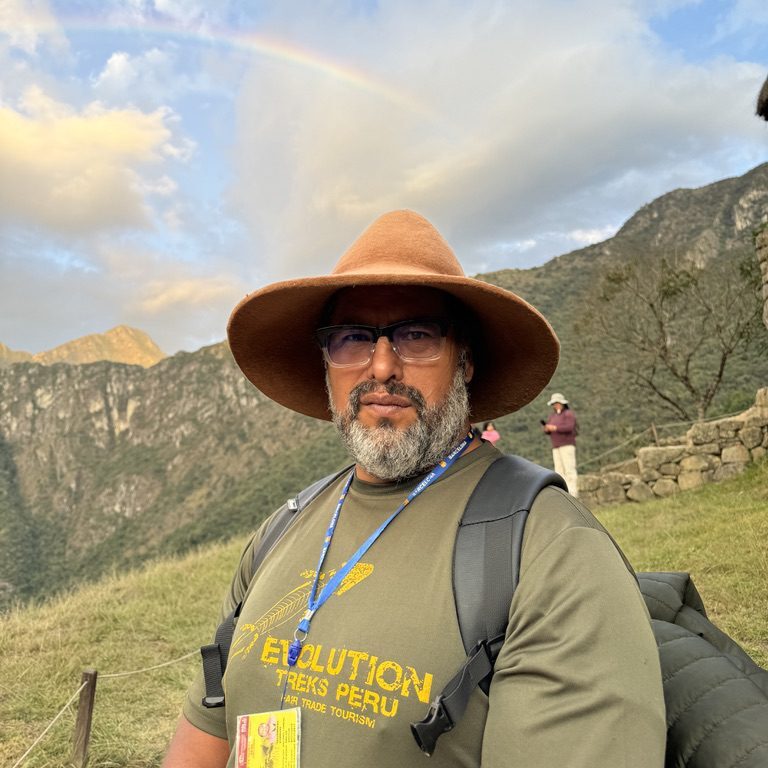
Miguel is a native Peruvian and a professional tour guide from Cusco with 30 years of experience conducting tours of Peru. A known authority on the country’s cultural and ecological diversity, Miguel is dedicated to introducing the beauties of his native land to visitors from abroad.
In 2003, he was invited to lecture at Hampshire College in Massachusetts on the topic of cultural appropriation. He has continued to share his expertise internationally, including lectures for Norway’s Outdoor Store Nomaden in 2017, and the John Hopkins University–CENTRUM Virtual Peru Global Immersion 2024: Cultural Activity, and the Tuinen Star Tourism Superior Institute. He appears as a key figure in the multi-award winning film The Last Tourist, which discusses the impacts of sustainable travel.
A passionate advocate of ethical, sustainable, regenerative tourism, and of scientific approaches, Miguel firmly believes in the beneficial role that thoughtful tourism has in protecting sensitive cultures, peoples, and ecosystems. He has devoted his life to enlightening to enlighten tourists, promoting that they be responsible stewards of the places they travel to.
Miguel is also the only one of the former Peruvian porters on the Inca Trail who has trekked to three of the world’s top hiking destinations: Everest Base Camp, Kilimanjaro, and the Inca Trail itself. He is currently campaigning to raise awareness of the exploitation and mistreatment of endemic to the trekking business, which particularly affects porters and sherpas on voyages to such popular spots as Kilimanjaro, the Inca Trail, Everest Base Camp, and K2 Base Camp.
His authoritative views have been publicized in major travel publications, such as Lonely Planet, Fodor’s Travel, National Geographic, BBC Travel, and many others.
Miguel is Co-Founder of Evolution Treks Peru, a worker-owned travel company based in Cusco. This attests to his commitment to equity and sustainability in the travel business.
Company: Evolution Treks Peru
We are thrilled to have you join us today, welcome to ValiantCEO Magazine’s exclusive interview! Let’s start off with a little introduction. Tell our readers a bit about yourself and your company.
Miguel Angel Gongora Meza: My name is Miguel Angel Gongora Meza, and I am the co-founder and director of Evolution Treks Peru, a worker-owned travel company based in Cusco, Peru.
I’ve spent nearly 30 years working in tourism, but I didn’t start out running a company. I began as a porter on the Inca Trail, carrying equipment for tourists, before becoming a professional guide. Those early years taught me a lot about the industry, especially how much work goes on behind the scenes to make a trek possible.
When we started Evolution Treks Peru, I wanted to build a company that treated the people doing that work as an important part of the business. We organize treks to Machu Picchu and other destinations in Peru, but our work goes beyond taking visitors from one place to another. We want travelers to understand the local culture, respect the environment, and recognize the people who make their journeys possible.
One of the things I’m particularly proud of is our work advocating for better conditions for porters and creating more opportunities for women in trekking, an industry where they have historically faced barriers.
I’ve also had opportunities to share my experience through international lectures and publications such as National Geographic and BBC Travel. But much of what I know about tourism still comes from my years working on the trails.
Running Evolution Treks Peru is about showing that tourism can be a successful business while also being fair to the people and communities who depend on it.
What was the moment you realized that complexity was holding your company back, and how did that shift your approach to product, operations, or strategy?
Miguel Angel Gongora Meza: I started noticing the problem when we were trying to improve working conditions for our porters at Evolution Treks Peru. Having worked as a porter myself, I knew how difficult it could be to carry heavy equipment through the mountains. I wanted our team to have better tents, proper meals and the equipment they needed to work safely.
But making those improvements wasn’t as simple as buying better equipment. Some of the camping gear added weight, which meant we needed more people to carry it. That increased our costs, and we had to think carefully about how everything would work together.
We eventually realized that adding more equipment wasn’t always the answer. We began looking at what we could make lighter or remove altogether. We switched to lighter camping equipment and worked with our cooks to reduce unnecessary food packaging. When we needed additional porters, we brought them in rather than expecting the same people to carry more.
That experience changed how I think about running the company. I now pay more attention to how one decision affects the rest of the operation. A small change in what we pack can affect our staffing, transport costs and how tired someone feels after a long day of walking.
I still believe in providing a good experience for our travelers, but I don’t want that comfort to come at someone else’s expense. Sometimes simplifying the operation means spending more money in one area to avoid creating bigger problems somewhere else.
Can you share one specific example of something you simplified (a product feature, process, pricing model, or customer experience) that delivered outsized results?
Miguel Angel Gongora Meza: One thing we simplified at Evolution Treks Peru was something most travelers never think about. The weight of the supplies our porters carry on the Inca Trail.
I used to work as a porter myself, and I remember how much harder a climb becomes when you’re carrying things that don’t really need to be there. When we started improving the equipment and meals for our team, we ran into a problem. Better equipment sometimes meant heavier loads, and we couldn’t keep adding more weight every time we wanted to improve something.
So we started questioning what actually needed to go up the mountain. We replaced heavier camping equipment with lighter alternatives and worked with our cooks to reduce unnecessary food packaging. We weren’t cutting back on meals or taking away things people needed. We were trying to stop carrying weight that served no real purpose.
What I like about this change is that the benefit goes to someone the customer might barely notice. A traveler can finish the trek without knowing how much thought went into the supplies, but the porter carrying them feels every kilogram.
We haven’t measured the improvement in a way that I could give you a percentage. But it changed how we approached packing and planning our treks. Instead of asking how much more we could bring, we started asking what we could leave behind without affecting the experience.
I think that’s something business owners can learn from. Sometimes the best improvement isn’t something new you give the customer. It’s something you stop asking your employees to carry.
How do you systematically identify and eliminate complexity across the organization without oversimplifying in ways that hurt quality or value?
Miguel Angel Gongora Meza: At Evolution Treks Peru, I pay attention to the work that happens before our travelers even put on their hiking boots. That’s usually where we find things that need changing.
A trek might look perfectly organized from the customer’s side, but that doesn’t mean the people running it have an easy job. Our porters could be carrying supplies that aren’t necessary, or our cooks might be dealing with food packaging that takes up space and adds weight. If we only asked travelers whether they enjoyed the experience, we would probably miss those problems.
Having worked as a porter myself, I know that the people doing the physical work often notice problems long before anyone in the office does. Their experience matters when we’re deciding what to change.
We look at what goes into each trek and question whether everything is necessary. We’ve replaced heavier camping equipment with lighter alternatives and worked on reducing unnecessary food packaging. But I wouldn’t remove something just because it saves money or makes planning easier. If it affects someone’s safety, meals or ability to rest properly, then we’ve gone too far.
I also think it’s important to know who benefits from a change. Making a trek cheaper to operate doesn’t mean much if the savings come from asking a porter to carry more or giving the team less time to recover.
Simplifying a business isn’t about having fewer things to manage. It’s about making sure the work we’re removing was never helping anyone in the first place.
What’s the biggest resistance you’ve faced when pushing for radical simplicity, and how did you overcome it?
Miguel Angel Gongora Meza: One of the hardest things to change in trekking is the idea that doing something the same way for years means it’s the right way to do it.
I saw this when we began bringing women into porter roles at Evolution Treks Peru. The Inca Trail porter industry had been dominated by men for a long time, and there were people who didn’t believe women belonged in that kind of work. I had worked as a porter myself, so I knew how demanding the job was. But I also knew that being a good porter wasn’t simply about being a man or being able to carry the heaviest load.
We had to look at what the job actually required. That meant preparing people for the physical demands of the trail, making sure equipment and loads were appropriate, and giving women the opportunity to train and prove they could do the work.
It wasn’t an easy change. Bringing women into the team required additional planning and training, and we faced resistance along the way. But we continued with the program, and our women porters eventually received international attention, including coverage from National Geographic and BBC Travel.
What stayed with me was how much unnecessary difficulty can come from an assumption nobody has bothered to question. We didn’t make the mountains easier or lower the standards of the job. We challenged the idea that only certain people should be allowed to do it.
Sometimes the hardest part of simplifying a business isn’t removing a process. It’s getting people to stop defending a rule that never needed to exist.
For other CEOs who struggle with feature bloat, process overload, or confusing customer journeys, what’s the most important principle or first step you would recommend they take?
Miguel Angel Gongora Meza: I would tell CEOs to find the person who has to deal with the consequences of a decision but wasn’t involved in making it. That’s where I would start looking for unnecessary complexity.
In trekking, someone sitting in an office can add another item to a packing list in a few seconds. But that item has to be carried by a real person, sometimes for hours along steep mountain trails. I’ve been that person. I started my career as a porter on the Inca Trail, and I know the difference between something that looks good on a plan and something that actually works in the mountains.
At Evolution Treks Peru, we’ve looked for ways to reduce unnecessary weight by using lighter camping equipment and cutting back on food packaging. The important question wasn’t how much we could remove. It was whether removing something would make the work easier without affecting meals, safety or the experience travelers paid for.
I think the same problem happens in other businesses. A CEO adds another approval to prevent mistakes, but now employees spend more time waiting. A company gives customers more options, but someone has to explain those choices when people get confused. The decision may seem small to the person making it, but the work doesn’t disappear.
My advice would be to follow one decision all the way to the person who has to carry it out. Ask them what makes their job harder without making the result better. You might find that the thing your business needs most isn’t another improvement. It’s permission to stop doing something that never helped in the first place.

