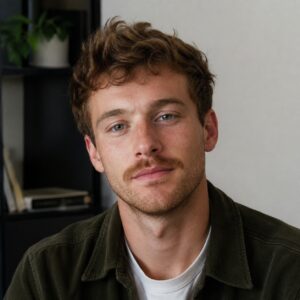

Architect, entrepreneur, and urban theorist Joseph Lambke believes the greatest threat facing modern cities today is denial.
“Architects build for the future,” he says. “We’re not building for the past, and we’re not even really building for the present.” This fundamental failure of awareness, Lambke insists, is defining the current urban crises. According to him, many cities continue functioning through assumptions formed during the industrial era, even as the realities shaping contemporary life have shifted completely.
The issue, he argues, is the inability to recognize how dramatically the world has changed.
He points to America’s largest cities as a warning sign.
For decades, Lambke highlights that the city’s official downtown, Loop, revolved around the energy of open-outcry trading floors. He observes the district’s architecture and commercial identity, including the Chicago Board of Trade, a premier Art Deco monument, and he remarks on the 1916 phrase: “Hog Butcher for the World”, highlighting an industry that once defined the city itself. Yet Lambke notes that urban planners ignored the inevitability of digital transformation, even as algorithmic trading and computer-based systems steadily replaced the physical trading floor.
“We knew computers were going to take over trading,” he says. “Everybody knew it. Nobody wanted to admit it.”
According to Lambke, the eventual departure of that industry hollowed out the district long before the pandemic accelerated office vacancies. He believes COVID merely provided a veil for a transformation that had already been underway for years. Office towers, he adds, now sell at staggering discounts, while companies and workers are migrating toward neighborhoods offering the lure of a more grounded quality of life. “The city doesn’t know what to do with the Loop anymore,” he says.

To Lambke, this reflects a broader pattern within urban development, where cities are reacting to change only after systems have already collapsed. He argues that many governing structures still function through zoning models built for another century, with systems that are designed to separate homes, factories, and commerce during the industrial age, long before mobility and digital infrastructure transformed how people live and work.
“The original zoning-by-function made sense when cities were organized around smokestacks and factories,” he says. “But mobility changed everything.” This immobile thinking, he believes, also fuels a powerful nostalgia shaping contemporary urban conversations. “The people who don’t live in the Loop suggest we can restore these old ‘grand’ lobbies, and yet the new generation that desires urban life prefers an amenity-saturated modern lifestyle. The race for luxury amenities is providing better economic returns than old-fashioned lobbies,” he says.
In Lambke’s view, cities often romanticize historic European models such as Paris or Barcelona while overlooking the vastly different demographic, technological, and geographic pressures defining modern metropolitan life. “We have to caution against desiring another society’s historical remnants,” Lambke says.
His response is polycentric urbanism, the framework that informs his work through Animate Architecture. Instead of concentrating economic and social life into a single downtown core, Lambke advocates for interconnected scaled places of villages, neighborhoods, districts, cities, and metropolises that combine housing, workspaces, leisure, food systems, and public gathering areas within localized communities.
He argues that large-scale centralized planning often strips cities of human familiarity. Polycentric systems, by contrast, can encourage repeated social interactions and stronger communal rhythms. He explains, “You begin to recognize ‘everyday people’, even if you never speak to them. This changes how one experiences daily life.”
Lambke sees this shift already emerging in second-tier American cities such as Nashville, Austin, Boise, and Salt Lake City. These cities, Lambke adds, retain a legacy of social warmth. In his view, while major metropolitan centers struggle with rising costs and cultural fatigue, smaller cities have become more adaptable and more socially open.

“Massive cities have lost their sense of purpose,” he says. “Today, people can feel worldly in small cities, which have become more ethnically diverse.” He points out that restaurants and communities that once existed only in global capitals can now flourish across smaller urban centers as well.
At the same time, he warns that demographic decline is reshaping urban infrastructure in ways few leaders are willing to confront directly. Lambke believes that falling birth rates are leaving cities with aging populations, underused schools, and mounting questions about how future neighborhoods should function. “Nobody wants to close a school because it feels like admitting a neighborhood is disappearing,” he says. “But these are realities cities have to face.”
Technology adds another layer to that challenge. Although Lambke remains deeply engaged with artificial intelligence and emerging systems, he rejects the notion that digital progress diminishes the importance of physical environments. If anything, he believes AI makes the material world more significant. He says, “The physical world still exists. We still need food, housing, transit, and energy. Those realities are becoming visible again.
Lambke’s concept, “KidCity,” is driven by that logic. It defines an urban approach guided by access to travel services. It is designed around families, adaptable mixed-use environments, and spaces capable of supporting long-term human relationships. It also shapes some proposals for stackable urban villages, such as mixed-use vertical communities designed to integrate manufacturing, residential living, commerce, and social life inside a connected ecosystem.
Yet Lambke says the greatest resistance to these ideas is psychological. He says, “The hidden barriers are phenomenological. People are unaware of the forces shaping their decisions.”
He draws a distinction between business interests and professional responsibility. Businesses, he argues, will always adapt quickly because survival depends on it. Architects, educators, doctors, and civic professionals carry a different obligation: stewardship.

“Professionals owe something back to society,” he says. That obligation, in Lambke’s view, demands a new kind of urban imagination, one that is willing to confront uncomfortable realities instead of preserving familiar illusions. He posits that visionary projects do not begin with spectacle or iconic towers. Every day, people begin with what they have seen and the imagination of desirables that might be impossible. Professionals begin with an assessment of the imaginative potential and the physical practical implications that must be woven together. Instead, he says, “the future demands the willingness to rethink how people could actually live.”
“Feedback used in a scale-based collaborative manner becomes more localized, more human, and opens new ways of living,” Lambke says. “Otherwise we’re just preserving systems that no longer fit the world we already live in.”