



Key Takeaways
- Lemma’s founders, Jerry Zhang and Cole Gawin, met as freshmen in USC’s startup incubator and built their first company, a medical billing tool, for Gawin’s mother.
- The idea for Lemma came from two unrelated internships, where both founders spent their days manually rewriting AI prompts until Gawin automated the task and worked his way out of a job.
- Gartner projects that more than 40% of agentic AI projects will be canceled by the end of 2027, a gap in reliability that Lemma built its entire product around closing.
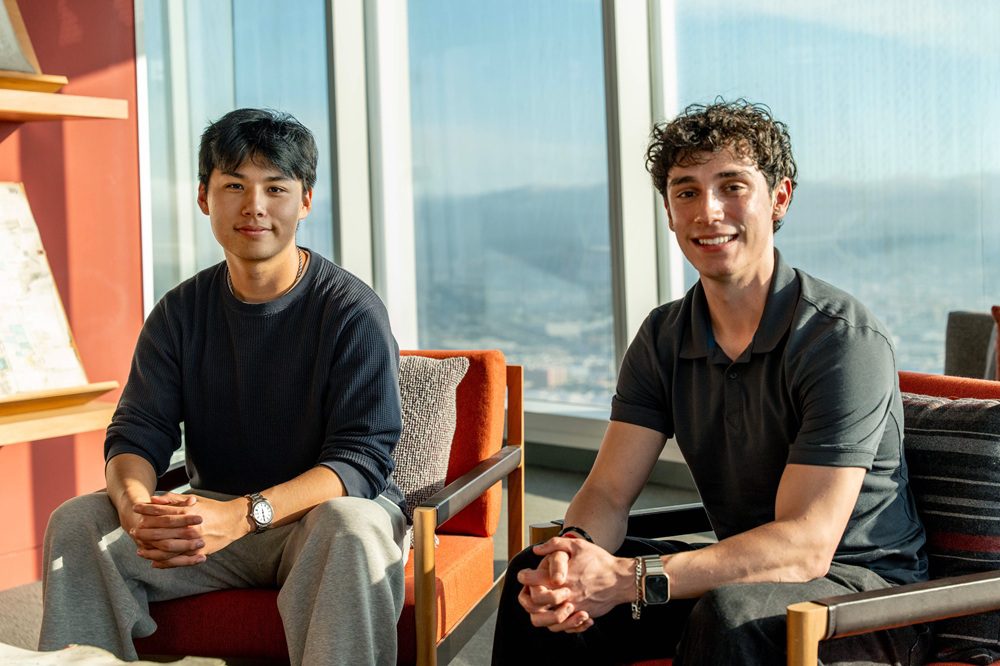
Jerry Zhang and Cole Gawin have been building things together since before either knew what a startup was. They met as freshmen at SEP, the University of Southern California’s student startup program, and their first company grew out of watching Gawin’s mother do medical billing by hand at her kitchen table. That instinct, noticing a task nobody enjoyed and building a way out of it, kept following the pair through college and eventually became Lemma, a tool that helps engineering teams catch AI agent failures that never trigger an alarm.
A Kitchen Table Problem, Solved at Eighteen
Zhang grew up in Canada, where he built a habit of winning. He carried a perfect GPA, competed in national math contests, and once ranked fourth in the country in the 200-meter breaststroke. Gawin’s path looked different. He taught himself to code in suburban Chicago at age nine, building a website for his soccer team, then getting stuck on a question that pulled him further in, wondering who actually built the tool he had used to build it.
This curiosity led him into PHP while he was still in elementary school, and by high school he was taking engineering internships and turning down a full-time job offer to attend college instead. He picked USC over his first-choice school to push himself out of his own introversion, then chose cognitive science as his major, with computer science as a minor, believing that anyone can learn to code from YouTube but that nobody can run a neuroscience lab alone.
The two put that energy into Clinicode, a tool for medical insurance paperwork inspired by Gawin’s mother, a physical therapist who spent hours every night filing claims after work. By eighteen, they were selling it to hospital staff around Los Angeles, and they became the first team at USC to win both Best Product and Best Demo with the same idea. Running a startup on top of a full course load caught up with them, and Clinicode folded before it could grow much further.
Two Internships, One Shared Problem
They found the real idea a summer later, from two different offices. Gawin was interning at a healthcare AI company, rewriting prompts by hand, changing a word, running the test, reading the result, and starting over. After a few weeks, he realized a program could handle that cycle, so he built one and automated his own job away. When he told Zhang, it turned out Zhang was stuck in the same loop at his own internship. Two people hitting an identical wall at unrelated companies suggested others were stuck there too.
An investor who had passed on Clinicode sent them $30,000 to keep building. Zhang talked a skeptical Gawin into applying to Y Combinator, and their interview came down to a single question, when a partner asked how their approach differed from DSPy, a research framework Gawin had read about that same morning. Gawin answered in detail, then opened his laptop for a demo nobody had asked for. Their acceptance call came the next day.
Building Toward a Reliability Product
Within Y Combinator, the two initially operated as a bespoke prompt consultancy, patching other teams’ agents by hand well enough to generate revenue and close a seed round. Zhang and Gawin worked with dozens of companies running AI agents in production, and the same complaint kept surfacing. Monitoring tools built for ordinary software could not keep pace with agents that fail without ever throwing an error. Gartner now projects that more than 40% of agentic AI projects will be canceled by the end of 2027, citing rising costs, unclear return on investment, and weak risk controls, a forecast that matched what the founders were hearing firsthand.
“Cole and I started Lemma because we experienced the pain of building AI agents firsthand,” said Zhang. “We kept running into the same problem: agents would appear to work, but the results weren’t reliable enough in production. We wanted to build the tools we wished we had, something that helps teams catch issues earlier, learn from production data, and continuously improve agent performance in the real world.”
Lemma now watches live production traffic for the failures that slip past ordinary monitoring, loops, broken tool calls, and misread requests, tracing each one back to its cause and proposing a fix engineers can push into their code. Lemma closed a $2.3 million pre-seed round backed by Matrix, Y Combinator, and operators from OpenAI, xAI, Meta, and DoorDash, and Forbes named it one of the standout startups from Y Combinator’s Fall 2025 batch. For two founders who spent a summer automating themselves out of their internships, building the tool that catches everyone else’s silent failures looks less like an accident and more like the only company they were going to start.
About Lemma
Lemma is a production monitoring and observability platform for AI agents. Founded by Jerry Zhang and Cole Gawin, who met as freshmen in USC’s startup incubator, Lemma helps engineering teams uncover hidden semantic failures, diagnose root causes across thousands of traces, and deploy automated fixes, enabling AI agents to continuously improve from real-world usage instead of silently degrading. To learn more or book a demo, visit www.uselemma.ai.