Growth is the goal for every insurance agency. More clients, more lines of business, more revenue. But growth has a way of exposing the cracks in operational processes that worked fine at a smaller scale.
For many agencies, the quoting process is exactly that kind of crack – manageable early on, but increasingly costly as the business expands.
The Quoting Bottleneck Most Agencies Ignore
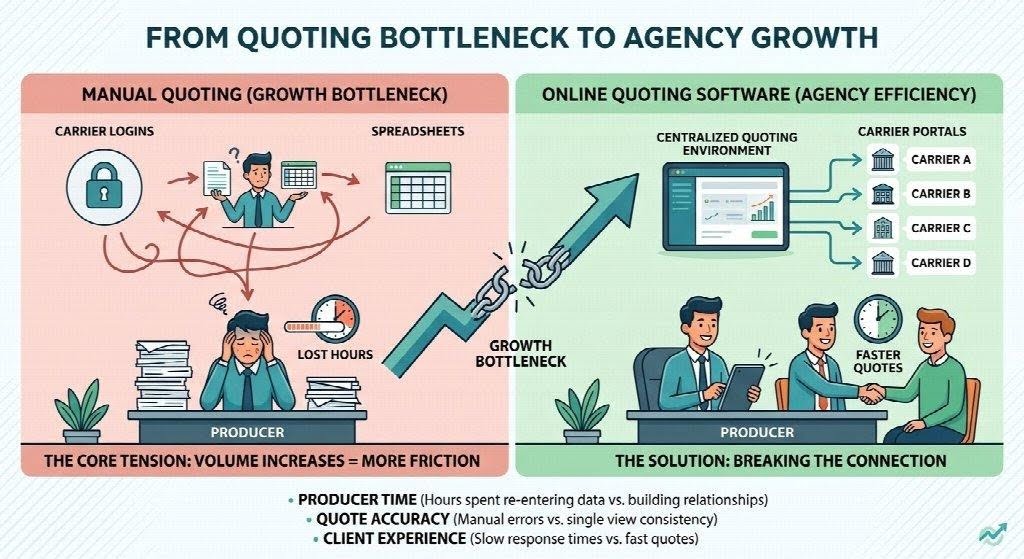
When an agency is small, producers can carry the quoting workload through a mix of carrier portal logins, spreadsheets, and institutional knowledge. It’s inefficient, but it works.
As the agency grows, that approach breaks down. Producers spend hours re-entering the same client data across multiple carrier portals. Mistakes creep in. Response times slow down. Clients who came to the agency expecting a fast, professional experience start comparing notes with competitors who are quoting them in minutes.
This is the core tension in agency growth: the very activity that drives revenue – getting clients covered quickly – becomes harder to do well as volume increases.
Online insurance quoting software exists specifically to break that connection between volume and friction. Rather than each producer maintaining their own portal-by-portal workflow, the agency operates from a centralized quoting environment where client data is entered once and compared across carriers in a single view.
The result is faster quotes, fewer errors, and producers who can handle more accounts without working longer hours.
What the quoting bottleneck actually costs agencies:
- Producer time – hours spent logging into carrier portals, re-entering the same information, and chasing down quotes that could be generated simultaneously are hours not spent building client relationships or closing new business
- Quote accuracy – manual data re-entry across systems is a consistent source of errors, and errors in quoting create E&O exposure, client frustration, and rework that slows everything down further
Building a Quoting Process That Scales
Fixing the quoting bottleneck isn’t just an operational improvement – it’s a growth strategy. Agencies that can quote accurately and quickly have a structural advantage when competing for accounts, particularly in lines like cyber liability where the market moves fast, and clients want answers before committing to a conversation.
The agencies that grow well share a few characteristics in how they manage quoting. They’ve standardized data collection so producers aren’t reinventing the intake process for every account.
They’ve reduced the number of manual handoffs between systems. And they’ve set expectations internally about turnaround time so that fast quoting becomes part of the agency’s identity with clients, not just an occasional win.
Technology enables all of this, but the process changes have to come first. Software doesn’t fix a broken workflow – it accelerates it. Agencies that implement quoting tools on top of inconsistent intake processes tend to see partial improvements at best.
The ones that get the most value from centralized quoting platforms are the ones that cleaned up the front-end data process before deploying the tool.
Growing Revenue Without Growing Headcount Proportionally
One of the most practical measures of operational efficiency for an agency is revenue per producer. If every new account requires the same amount of manual quoting work, revenue scales with headcount – and headcount is expensive.
When quoting becomes faster and more standardized, producers can serve more accounts in the same hours, which changes the math on what growth actually costs.
This matters most in the middle stages of agency growth, when the team is too large to run on pure hustle but not large enough to absorb the cost of additional producers without those producers generating meaningful new revenue quickly. Tightening the quoting process is one of the highest-leverage operational moves available at that stage.
What agencies typically see when quoting becomes more efficient:
- Shorter sales cycles – clients who get a fast, well-organized comparison of options are easier to close than those waiting days for quotes to come together from different sources
- Better renewal retention – structured quoting workflows create documentation that makes renewal conversations easier to prepare for, and clients who feel well-served at renewal are less likely to shop around
The Competitive Case for Getting This Right Now
The insurance market is changing in ways that reward operational speed. Lines like cyber liability, which didn’t exist at scale a decade ago, are now high-demand products where clients expect quick turnaround. Agencies that are still quoting cyber through manual carrier portals are slower than competitors who have centralized the process, and in a competitive market, slower usually means losing the account.
Growth doesn’t have to mean grinding harder. The agencies expanding most effectively right now are the ones treating their quoting infrastructure as a competitive asset – investing in it early so it can carry more volume without adding friction. That’s the kind of growth that compounds.