



In freestyle personal watercraft competition, talent is only part of the equation. A rider can train harder, refine technique, and take greater risks, but the craft beneath them still contributes to the trick to be completed. For Eric Malone, that relationship between athlete and equipment became the starting point for an unexpected move into personal watercraft development.
Malone, founder of Eric Malone Enterprises LLC, explains his approach in simple terms. “It all came down to, ‘What do you have to do to win?’ That was all it was.” Earlier in his career, he was contracted as a factory rider with all 3 major standup watercraft manufacturers, providing a network of tools while performing at the highest level. The International Jet Sports Boating Association lists Malone among its Pro Freestyle world champions across multiple years, including 2004, 2005, and 2006.
For a freestyle rider, that competitive environment made mechanical decisions difficult to separate from athletic ones. IJSBA, the sport’s sanctioning body, governs competition rules as well as watercraft eligibility and preparation. Malone’s recollection of his career reflects that connection. When rules changed, the changes affected more than what could be entered in a competition. They also created new possibilities for what was possible on a jet ski.
The shift from a factory sponsored athlete to builder became more urgent in 2004. Between 2003-2004, Malone was in talks with Polaris to design and create a new hull that was freestyle/freeride specific, but Polaris, stopped manufacturing marine products that September, a decision documented in the company’s filing with the U.S. Securities and Exchange Commission. Malone says the loss of factory support arrived as competition rules were also creating room for bigger displacement engines and aftermarket hulls.
That combination changed his options for the first time in 20 years. Rather than depending entirely on a factory machine, he began thinking more directly about what he could build for himself under the new regulations.
“When IJSBA changed the rule from 800cc to 1000cc, I used Polaris factory support,” Malone says. The Rule changed in 2004. He explains that the years of development already taking place around the Polaris engine, including big-bore components, helped him develop the first 1000cc engine and later 1200cc engine, both first of their kind.
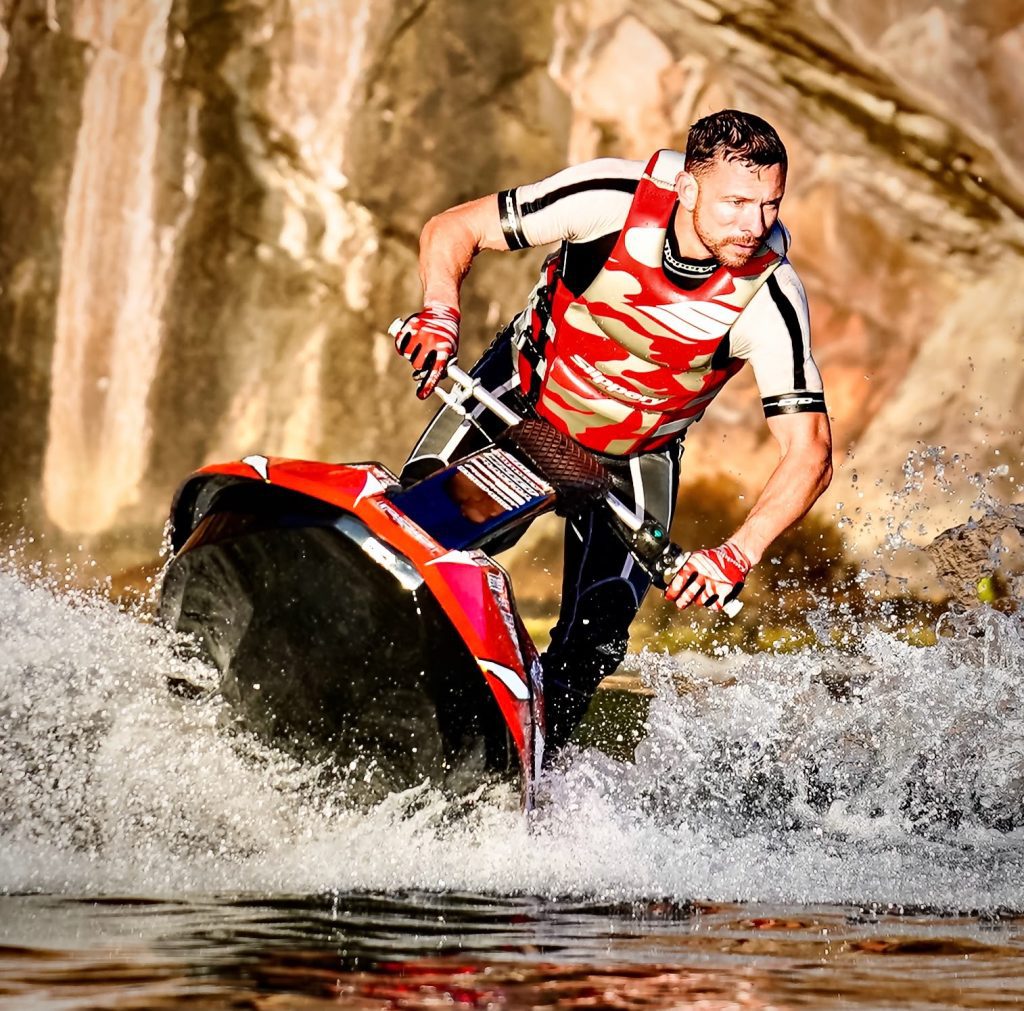
The engine, however, was only one part of the equation. Malone also points to years of training, less weight, its distribution, and altering the hull design for freestyle. At the 2004 World Finals, he says that combination helped him perform what he describes as the first flat-water backflip. The milestone remains Malone’s account, while IJSBA records independently confirm that he won the Pro Freestyle World Championship at Lake Havasu that year.
That experience reinforced a pattern in Malone’s career. A technical problem would emerge from competition, and the response would become part of the craft itself. Instead of treating product development as separate from riding, he began to see the machine as another element of preparation.
His development work then moved beyond the engine. As rules opened the door to aftermarket hulls, Malone says he began shaping his own designs around the kind of freestyle performance he wanted. The process was still driven by competition rather than a broad business strategy.
“I opened up an LLC, and I started making jet skis based on my design,” he says. What began as equipment intended for his own use quickly attracted interest from other riders overnight. Malone says professional competitors wanted access to similar setups, turning a personal development effort into a manufacturing business.
The timing also matched continued competitive success. IJSBA records list Malone as Pro Freestyle world champion in 2005 and 2006, following his 2004 title. He says he stepped away from competition after 2006 and increasingly focused on athlete support, training, products, and personal watercraft development through EME. In his telling, demand followed performance: riders saw what the equipment could help make possible and became interested in using related designs themselves.
Looking back, Malone does not frame the transition as a carefully mapped entrepreneurial plan. The business grew from a narrower problem: how to make equipment that could win championships. “The product development is a big part of the athlete,” he says.
That idea continues to shape his view of the industry and his work. For Malone, product development began as a competitive necessity, then expanded into hull design, manufacturing, and collaboration with other riders. The wider business came later. The first question was much smaller, and much more immediate: what would it take to win?