

An accident doesn’t always happen because of one big mistake. More often, it begins with something small. Something that could have easily been prevented.
A worker slips and falls because the floor was still wet. They get tangled up in a loose cable, lift something heavy with no help, or try to turn on a machine that has not been checked in months.
That is why workplace safety has to be part of the daily routine, not something you think about only after an incident. After a serious injury, a worker may even find themselves typing “Personal injury lawyer Middletown” into Google while trying to understand what happens next. Businesses can prevent many of these situations by paying attention to simple risks before they turn into bigger problems.
In 2024, private industry employers in the US reported 2.5 million nonfatal workplace injuries and illnesses. That was the lowest total in the Bureau of Labor Statistics series going back to 2003, but the number is still large enough to show why safety deserves regular attention.
Start by Looking for the Ordinary Risks
You can start by taking a walk through the workplace and taking a look at what people deal with every day.
Are boxes stacked too high? Are the walkways blocked? Do employees have to reach for supplies? Are cords stretched across areas where people walk? Is a machine making a strange noise that everyone has learned to ignore?
These details are easy to overlook because they become familiar. Familiar, however, does not mean safe.
Ask your employees what slows them down or makes a task harder. They often know about issues that managers never see from their office.
That kind of feedback is useful because safety is not only about following the rules. It is about what actually happens during a normal workday.
Give People Training They Can Actually Use
A safety manual sitting in a shared folder does not protect anyone.
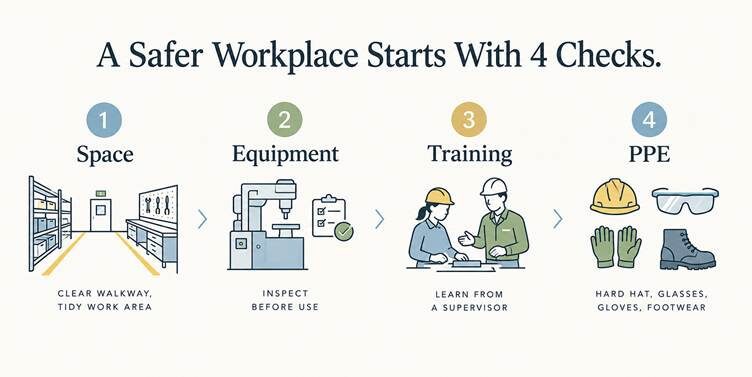
Employees need training that matches the work they really do. A warehouse employee needs to know how to move loads, use equipment, and keep clear of moving vehicles. Someone working with electrical equipment needs to know how to spot damaged cords and unsafe setups.
Keep the training clear. Show people what to do rather than filling a session with long explanations.
It also helps to repeat key points. New employees should get safety training when they start, but existing employees need refreshers when equipment, tasks, or workplace conditions change.
Never assume that someone knows a task just because they have done it before.
Make Protective Equipment Part of the Routine
Personal protective equipment, or PPE, works best when using it feels like an everyday thing.
Depending on the job, that can mean safety glasses, gloves, hearing protection, high-visibility clothing, protective footwear, or fall protection.
But handing someone PPE is only part of the job. The business also needs to make sure the equipment fits, is in good condition, and is easy to access. Employees should know when to wear it, how to use it, and when to replace it.
Poorly maintained safety gear can create a false sense of security.
Keep Machines and Work Areas in Good Shape
Maintenance is one of the least exciting parts of running a business. It is also one of the most useful.
You should regularly inspect your machines. Also, keep the space in good condition.
Good lighting can help people spot obstacles. Clear aisles give workers room to move safely. And your exit routes should stay accessible at all times.
Make It Easy to Report Problems
Some businesses have safety rules, but employees still hesitate to report problems.
Maybe they do not want to seem difficult. Maybe they think a supervisor will get annoyed. Maybe they have reported the same issue before, and nothing changed.
That silence creates risk.
Give employees a simple way to report any issues. The process can be as basic as a digital form, a shared safety log, or a clear person to contact.
Prepare for Emergencies Before You Need To
No business can remove every risk. Emergencies still happen.
Employees should know where to go, who to contact, how to report an injury, and what to do during a fire, chemical spill, severe weather event, or another emergency that fits the workplace.
Run drills every now and then. Check emergency equipment. And review the plan when your workplace changes.
A plan people have practiced is much easier to follow than a plan they have only read once.
Safety Starts With Leadership
Employees notice what managers do.
If a supervisor walks past a blocked exit, workers learn that blocked exits are not a serious issue. If a manager stops a task because a safety step was skipped, workers learn that the rule matters even when the work is busy.
This does not require dramatic speeches. It requires consistency.
Small Fixes Can Prevent Big Problems
Workplace health and safety matters. And it’s not about one perfect solution. It’s about creating a routine that’s easy to follow and catching ordinary problems early.
Repair the old machine. Replace the damaged cable. Ask the employee who actually does the job what could be safer.
Then keep checking.
When businesses make those habits part of normal work, they reduce the chances that one small oversight will turn into a serious accident. That protects employees, keeps work moving, and makes the workplace safer for everyone who walks through the door.