There’s a moment every digital product team eventually faces: you’ve invested in a beautiful website, a polished onboarding flow, and a robust support center and your customers still feel like strangers. They bounce. They churn. They email asking for something that was right there on the page. The problem isn’t your product. It’s that your digital customer experience services are treating every visitor the same way, regardless of who they are or what they actually need.
AI-powered personalization changes that equation entirely. And in 2025, it’s no longer a competitive advantage reserved for companies with thousand-person engineering teams. It’s becoming table stakes and the brands that understand it earliest will be the hardest to unseat.
89%
of businesses compete primarily on digital customer experience
3×
higher revenue growth for companies excelling at personalization
71%
of consumers expect companies to deliver personalized interactions
Why Traditional Personalization Fell Short
For years, personalization meant segmentation: drop users into buckets by industry, company size, or geography, then show them a slightly tailored version of your standard content. It was better than nothing but it was also slow, manual, and built on assumptions that aged quickly.
The problem is structural. Segments are averages. A “mid-market SaaS buyer in the US” is a useful abstraction for planning, but it tells you almost nothing about the specific person on your pricing page at 11:47 on a Tuesday who came from a LinkedIn ad, has visited your competitors twice this week, and is on their third session in four days. That person deserves something more targeted than “here’s our mid-market case study.”
This is where AI-powered digital customer experience services make a fundamental departure. Instead of fitting customers into predefined segments, they build individualized models of intent in real time, at scale, without a human in the loop.
“Segments are averages. AI personalization treats every visitor as an individual, not a data point in a bucket, but a signal-rich moment waiting to be matched.”
The Core Technologies Driving the Shift
Behavioral Signal Processing
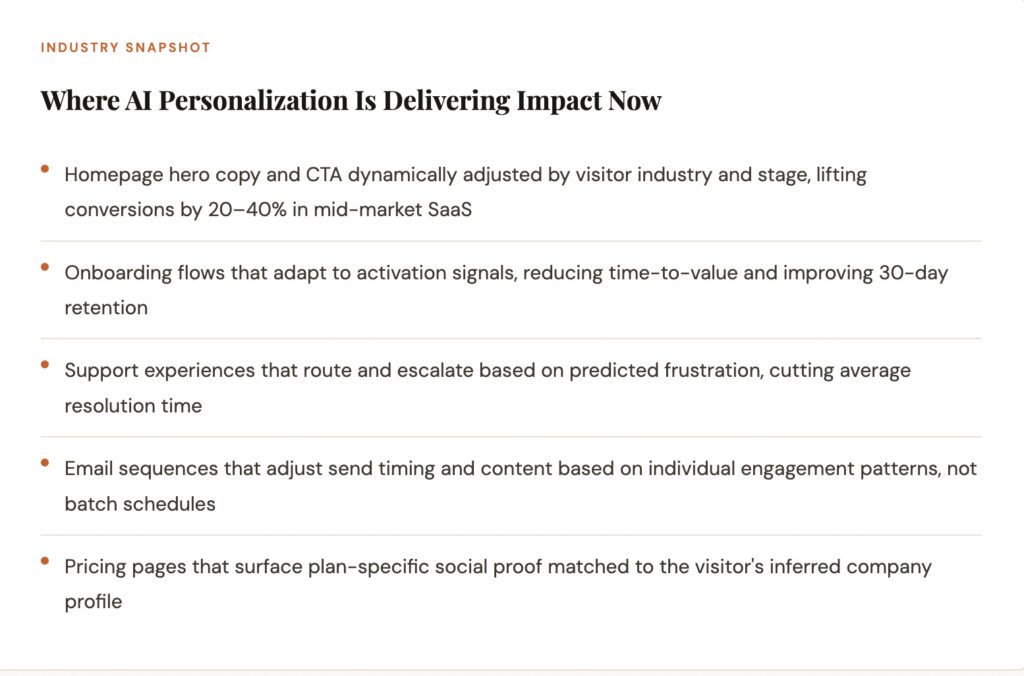
Modern AI personalization engines ingest dozens of behavioral signals simultaneously: scroll depth, click patterns, time on page, return visit frequency, referral source, device type, and session cadence. Individually, none of these tells you much. Together, they form a real-time portrait of intent that’s far more nuanced than any segment definition.
A first-time visitor who lands on your pricing page after a Google search for “enterprise CRM alternatives” is very different from a logged-in user who navigates to the same page after opening a product email. AI systems recognize these distinctions and respond accordingly surfacing different CTAs, testimonials, or messaging to maximize relevance in that specific moment.
Predictive Content Optimization
Beyond reactive personalization showing different things based on what just happened, leading digital customer experience services are now deploying predictive models that anticipate what a customer will need before they ask for it. Think of it as intent forecasting: if behavioral patterns indicate a user is approaching a decision point, the experience proactively surfaces the evidence they’re most likely to find convincing a relevant ROI calculator, a peer comparison, or a prompt to speak with a specialist.
Platforms like Dynamic Yield, Mutiny, and Fibr AI are pioneering this approach, allowing B2B and SaaS companies to run continuous personalization experiments across their entire web presence without requiring engineering involvement for each variation.
Multimodal and Conversational Personalization
The newest frontier involves AI that adapts not just what content is shown, but how it’s delivered. Conversational AI embedded in product interfaces can now adjust tone, complexity, and format based on a user’s profile and demonstrated preferences. A technical buyer gets precise specs and API documentation. A business buyer gets an executive summary and an ROI model. Same underlying product, radically different experience.
Omnichannel Coherence: The Unsolved Problem AI Is Fixing
Personalization on a single page is useful. Personalization that follows a customer across channels is transformative. And this is where most organizations still have significant gaps.
Consider a typical B2B buying journey: a decision-maker discovers your brand on LinkedIn, reads a blog post, downloads a guide (which goes to their work email and stays unread for three days), then returns directly through a browser bookmark to explore your features page. Most companies treat these as four separate interactions. AI-powered digital customer experience services treat them as one connected thread.
Unified customer data platforms (CDPs) like Segment, mParticle, and Amplitude now provide the infrastructure to stitch these touchpoints together. Paired with AI decision engines, they allow brands to maintain context across sessions and channels — so the conversation you started in an email continues naturally when the customer arrives on your website, or when a sales rep calls the next morning.
Experimentation at the Speed of AI
From A/B Tests to Continuous Optimization
Traditional A/B testing is a snapshot. You run a test, wait for statistical significance (typically two to four weeks), declare a winner, and deploy. By the time you’ve iterated five times, a quarter has passed. AI-powered experimentation compresses this cycle dramatically.
Multi-armed bandit algorithms continuously allocate traffic to better-performing variants in real time, without waiting for a fixed test window to close. Bayesian testing frameworks update their confidence estimates dynamically as data comes in. The result is a system that learns faster, wastes less traffic on losing variants, and adapts when external conditions shift — like when a competitor launches or a news cycle changes buyer sentiment.
For teams managing digital customer experience services at scale, this shift from episodic to continuous experimentation is one of the highest-leverage changes they can make. It transforms optimization from a quarterly initiative into a permanent operating mode.
AI-Generated Hypotheses
The most advanced teams aren’t just running AI-assisted experiments — they’re using AI to generate the hypotheses in the first place. By analyzing patterns across thousands of sessions, AI systems can identify friction points and optimization opportunities that human analysts would miss or take weeks to surface. What used to require a CRO agency retainer is beginning to look like a background process.
“The brands winning at digital experience aren’t just running more experiments. They’re running smarter ones with AI generating the hypotheses humans used to spend weeks forming.”
Agentic AI: The Next Evolution in Customer Experience
If real-time personalization is the present, agentic AI is the near future — and it’s arriving faster than most roadmaps anticipate.
Agentic AI systems don’t just respond to customer actions; they take autonomous, multi-step actions on a customer’s behalf. In a digital experience context, this might mean an AI that notices a user struggling with a billing configuration, proactively opens a support interaction, resolves the underlying issue, updates the account, and sends a confirmation — without any human triggering the sequence. Many growing companies are also turning to Customer Support Outsourcing providers to combine human expertise with AI-driven personalization, helping them deliver faster responses and more consistent omnichannel customer experiences.
This matters for digital customer experience services because it shifts the model from reactive (customer encounters a problem → customer asks for help → help is provided) to anticipatory (AI detects pre-problem signal → AI resolves before customer notices). The customer experience becomes invisible in the best possible way — frictionless because friction never got the chance to exist.
Companies like Intercom, Zendesk, and a wave of AI-native startups are already shipping early versions of this capability. Within two years, agentic handling of routine customer interactions will be an expectation, not a differentiator.
What This Means for Your CX Strategy
Data Ownership Is the Prerequisite
None of this works without a strong first-party data foundation. Third-party cookies are gone. Algorithmic personalization built on borrowed data is fragile. Organizations that invest now in owning their customer data — through progressive profiling, account-based identity resolution, and CDP infrastructure — will have a durable advantage as AI personalization capabilities mature.
Ethics and Trust Are Non-Negotiable
Personalization that feels helpful creates loyalty. Personalization that feels surveillance-like destroys it. The line between the two is thinner than most brands realize, and it’s crossed when customers can’t understand why they’re being shown what they’re being shown, or when their data is used in ways they didn’t anticipate. Strong consent frameworks, clear value exchange, and transparent data practices aren’t just compliance requirements; they’re the foundation on which effective personalization is built.
Start Narrow, Then Scale
The most common mistake organizations make when building AI-powered digital customer experience services is trying to personalize everything at once. Start with one high-traffic, high-stakes surface: your homepage, your pricing page, your onboarding sequence and prove the model there before expanding. The infrastructure, the organizational habits, and the data confidence you build in one area transfer cleanly to the next.
Conclusion
AI-powered personalization isn’t a feature you add to your digital experience. It’s a fundamental rethinking of what your relationship with customers can look like, one where every interaction is an opportunity to demonstrate that you know who they are, what they need, and how to help them get there faster.
The tools are mature enough. The data infrastructure is accessible. What separates the leaders from the laggards now isn’t technology budget, its strategic clarity and the willingness to treat digital customer experience services as a core growth discipline rather than a support function.
The customers who feel understood stay longer, spend more, and tell others. That’s not a personalization outcome. It’s a business outcome. And AI, done right, is the most powerful engine for getting there that has ever existed.