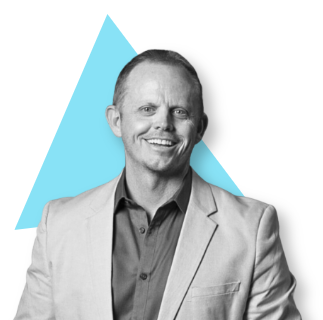

Craig Calder is a former EY partner, artist, author of soon to be released book, Problem Hunter*, and founder of ThinkClear Group, a consulting practice that supports leaders and teams develop expert problem-solving cultures and capabilities.
Craig grew up in Melbourne, Australia, holds a business degree from RMIT University and is a qualified Chartered Accountant. He works from his adopted hometown of Sydney after having spent many years living and working in both Toronto and London.
Craig’s journey from junior accountant and management consultant to leadership adviser, artist and author has taught him that the most rewarding and valuable work comes when you find challenging problems and have the courage to stay with them until they are solved. To not just stare at a problem and tell others about it, to do the work to find solutions and create change that matters.
*Problem Hunter is a book that aims to help people accelerate their careers and leaders create unstoppable teams and businesses by learning how to one thing really well: and that is finding and solving problems that matter. It’s the ultimate guide to remove hidden barriers, widen perspectives and learn the strategies and capabilities of some of the world’s most accomplished problem solvers. Packed with insights from architects, artists, CEOs, educators, medical specialists, neuroscientists, and more, Problem Hunter is more than just a book—it’s a roadmap to mastering one of life’s most valuable skills.
Company: ThinkClear Group
We are thrilled to have you join us today, welcome to ValiantCEO Magazine’s exclusive interview! Let’s start off with a little introduction. Tell our readers a bit about yourself and your company.
Craig Calder: Hi George,
I’m a former EY consulting partner, founder of leadership development and consulting firm ThinkClear Group, and author of Problem Hunter, a guide to becoming the most valuable person in any organisation. I have a business degree from RMIT University, Chartered Accountant qualifications, and 25 years of consulting and leadership experience, having worked with over 150 private companies and public organisations across Australia, North America, and Europe.
ThinkClear Group provides training, consulting, and coaching that doesn’t just help leaders build high-performing teams—we transform them, fast. Too many teams fall into the trap of waiting to be told what to do, held back by the fear of making mistakes rather than driven by the pursuit of progress. The relentless focus on productivity and compliance has unintentionally disconnected people from the engines of value within them. We help teams reclaim their problem-hunting instincts, making it easier to build cultures where taking initiative isn’t just encouraged—it’s the foundation of team success and personal growth.
What are your top personal and professional goals for 2025, and how do you plan to achieve them?
Craig Calder: 2025 is all about the launch of my new book Problem Hunter and supporting more leaders create unstoppable teams by teaching them how to do one thing really well: find and solve problems that matter through my training, consulting and coaching business.
To help me create awareness in a very crowded market, I’m using a seasoned publicist Nicole Webb to guide where I place my marketing focus and business accelerator Dent, to support how I build out the business model and assets that will connect me with more clients.
To help keep my mind clear and focused, I meditate for 15 minutes every morning using a Shakti matt and journal my reflections on the day before and intentions for the day ahead. I make it a habit to have at least one moment of gratitude in my journal. For a person, event or little win. The mind can’t hold anxiety and gratitude at the same time. Focusing on gratitude helps me stay calm when the alligators of anxiety are nipping around my legs.
To keep my body strong and able to sustain the energy I need to be creative and productive, I work out 5 mornings a week, three with a trainer. I’m now 50+ and have switched over the past five years to exclusively focus on strength work and flexibility. I get some of my most creative ideas and breakthroughs when I’m working out. I don’t use headphones and allow my mind to wander and create the connections it needs to help solve the challenging problems I have.
I take creatine, BCAA and magnesium supplements to boost muscle growth and recovery. Creatine has cognitive enhancing properties as well. I’m also taking Tribulus supplements to boost my focusing ability. I’ve found I need to be conscious of the amount of protein I eat each day to maintain muscle growth and sustain energy. I eat either eggs or fat reduced yoghurt with protein powder in the morning, tuna poke bowl or salad for lunch and a salmon or other fish protein and veg for dinner. My aim is 1.8g protein per kg of weight each day.
Looking back at 2024, what was the biggest lesson you learned, and how will it influence your approach in 2025?
Craig Calder: I spent much of last year researching and writing my new book Problem Hunter. I interviewed dozens of people from around the work and read over 100 books to help me distil the key insights of how expert problem solvers develop their perspective, mindset, strategies and capabilities.
This was my first widely published book. Before this, I was a hardened powerpoint junkie. Trained to simplify complexity into key messages so leaders could understand than quickly and act fast, and people looking to learn could get the points they needed without distraction. When I started to sit down and write the book I faced a block. A belief that I had no business writing a 70,000 work book. When I dived into this belief, I found it was rooted in an experience of coming very close to failing English in my last year of high school. I didn’t realise it until I looked into it, that but this belief was creating a block that because I ‘almost failed’ English it was likely I would fail at writing the book too. The belief caused procrastination and excessive rewrites in the early stages of writing the manuscript. It wasn’t until I found the technique of Mindset Reset where you expose the belief that holds you back, switch it for the opposite and lock it in with a new experience and emotion to block out the old belief that I was able to allow my creativity and productivity really accelerate.
What I learned form this is where you face self imposed barriers such as procrastination, perfectionism, self doubt or high levels of anxiety about a new challenge, its likely to be rooted in a limiting belief that can be discovered and written over, like replacing an old file with a new one on your computer. Beliefs drive behaviour and without exposing the ones that hold us back, we stay stuck. Beliefs are the apps our mind uses to take action.
I’ve learned that as soon as I feel any resistance or friction to what I want to do, I spend time in the morning working through what beliefs might be causing it and take the Mindset Reset steps (which are in my book) to clear them out and write over them.
One of the steps I took to clear the belief that I couldn’t write a book, was to write and publish one for my daughter’s 16th birthday which was in June last year. Something important but just for me. I got the idea from Rick Rubin when he said to unlock his creativity he creates things just for him. Diary entries that no one else has to see.
The book I wrote was is called “My Little Book of Wisdom, Stuff I’ve learned, been inspired by or wish I had learned sooner”. I self published it, created the cover and had it printed for her. It’s a collection of 200 pages of ideas and experiences I’ve had and the lessons I learned from them along with quotes of people that have inspired me over the years. The idea for the book was to condense my wisdoms into a bite size and digestible form for my daughter to consider as and when she wanted to. Each page has one or two ideas that are expressed in 25 words or less. She loved it and it proved to myself that I could do the ‘hard thing’ of writing and publishing my business book, Problem Hunter. That gave me the evidence and significant emotional memory to overwrite the old belief holding me back and set me free to be creative and productive.
The path of resistance often lies in our minds. Letting go of old limiting beliefs and replacing them with enabling ones is the fastest way to achieving bold goals I’ve found.,
What trends or innovations do you predict will significantly impact your industry this year?
Craig Calder: As the economy moves through the last phases of rebalancing post COVID stimulus, we will likely see more pressure to cut costs and reshape business models to cope with demand shifts globally and domestically. The pace of business model adaption to AI will grow exponentially this year and as new capabilities emerge the winners will be the ones fastest to spot how this new tech will either create new solutions to customer problems or replace or enhance existing ones. Leaders that create cultures not only adaptive to change but to hunt for and shape that change will outperform.
Centrally led change initiatives will be too slow to take advantage of technology shifts. And it greatly undermines and wastes the creative talent latent with each person. Decentralising innovation and putting it in the hands of everyone within a team will lead to faster adaptability.
Once off training programs that aim to inspire change, and new skills will likely fall away in demand as they become viewed as ‘educational entertainment’. Learning without action guarantees investment in training will be wasted within 72 hours of it taking place. Instead, I see a rise in structured coaching programs to help an entire team shift their thinking and develop the new skills they need together. A mix of education, accountability and collaborative learning experiences will create a powerful shift in culture and capability within a few short weeks.
How do you approach goal-setting and maintaining focus throughout the year?
Craig Calder: I spent two days in Thredbo Ski Village over new year. I make it a habit of being in an inspiring location to open my mind to possibilities for the year ahead. I sat on the deck of a lodge and looked up at the mountains and gave my mind questions to ponder. And when I thought of a goal I asked two questions of it to make sure it was the right one: 1. Is it bold and big enough? 2. In 12 month’s time and I’ve achieved it will create the step change I want?
I’ve found my mind looks to sand bag my goals subconsciously. I need to run a filter over what I come up with first and when it feels like I have a little bit of ‘sick’ in my throat at how big it is, I know I’m on the right path.
Focus is a practice not a mindset for me. I have daily routines to help me create focus and maintain it. I exercise 5 x week, meditate and journal daily and take supplements to help sharpen my focus and mental clarity. I take creatine, magnesium and tribulus supplements. I also drink at least 2 litres of water a day to maintain optimum brain function.
What advice would you give to other leaders and entrepreneurs looking to make 2025 their best year yet?
Craig Calder: What you believe you become. It sounds simple but the biggest shift I’ve had in my mental clarity and business performance over the past year is from exposing and removing limiting beliefs. They were apps running in the background subconsciously sabotaging my performance. While it may feel like wasted effort to dive into your mind and clear out these old ‘programs’ because it’s not typically action oriented, the results for me have been staggering. It’s like going into the garage with a normal car and coming out with a super car, lighter, higher powered and with the suspension to tackle bends and turns at high speed. I wished I’d learned this decades ago.
The Mindset Reset method has three steps:
1. Expose it – identify and label the limiting beliefs and behaviours holding you back.
2. Switch it – develop alternative, empowering beliefs and behaviours that better support you and propel you forward (often the opposite of the limiting belief)
3. Bring it in – lock in the new, empowering beliefs into your mindset with new memories, emotions and intentional actions that create and reinforce the change you want to make.