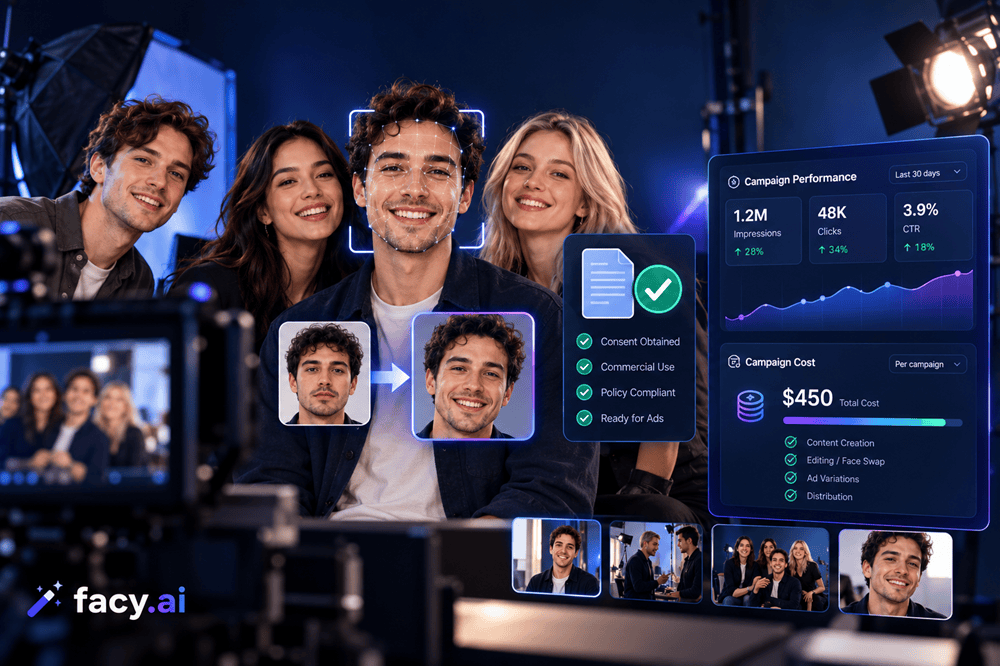
Yes, founders can use AI face swap in ads, and for a small team it’s one of the cheapest ways to keep creative fresh. The catch is that most startups don’t have a talent problem. They have a volume problem. One photoshoot gives you a handful of strong images, but paid social wants new variations every couple of weeks, and booking a studio each time isn’t realistic when you’re watching your runway. Face swap closes that gap: one good shoot becomes many audience-specific variants, with no extra call sheet.
Yes, with three conditions. Use your own face or licensed models with written consent, expect an AI label on platforms like Meta, and never use a swap to invent a customer. Meet those and one shoot can feed weeks of fresh ad variants.
Why does ad personalization keep demanding more visuals?
Two things push founders toward more visuals. First, audiences expect ads that feel made for them. McKinsey’s widely cited research found that 71% of consumers expect personalized interactions and 76% get frustrated when they don’t get them. It’s a 2021 study, but the direction hasn’t changed.
Second, platforms punish repetition. When people see the same creative too many times, results get more expensive. Meta flags this in Ads Manager: an ad shows as “creative limited” when cost per result rises above past ads, and as “creative fatigue” at 2x or more. Practitioners commonly rotate Meta creative every two to four weeks on higher-spend campaigns. For a lean team, that cadence is the real bottleneck.
How can founders use face swap in an ad workflow?
AI face swap replaces the face in one photo with a face from another and matches the lighting and skin tone. For ads, think of it as a way to make more usable versions of an honest shoot, not a way to disguise anything.
- Shoot once. Capture hero product images in clean, even light, with yourself or a licensed model.
- Swap with consent. Run each image through a photo face swap tool such as Facy.ai, using only faces you own or have written permission to use. It accepts JPG, PNG, WEBP, BMP and GIF files up to 20 MB.
- Localize. Use different licensed models for different markets or age groups, instead of booking a new shoot for each.
- Test and rotate. Launch variants as separate creatives, then retire the ones that start to fatigue.
Here’s how that plays out. Say a skincare founder has one strong shot of her serum with a single licensed model. If two other licensed models agree to the same use, she can build regional versions of that image in an afternoon instead of rebooking a studio.
Results look best when the source face is front-facing and the lighting and angle roughly match the target photo. Single-photo swaps on that page need no sign-up, so you can test a concept before committing any budget.
What does it cost to produce ad variants at scale?
Less than a reshoot, and the entry tiers are cheap enough to test.
| Plan | Monthly price | What ad teams get | Best for |
|---|---|---|---|
| Facy.ai Free | $0 | Unlimited image processing at medium quality, slower processing | Testing one or two concepts |
| Basic | $19.99 | Batch image processing, 4K UHD quality, fast processing, no captcha | Founders producing weekly variants |
| Plus / Pro | $89 / $399 | Same image features as Basic, plus 25 or 30 videos per month and longer video length | Teams adding video ads |
| Artguru Mini | $4.99 | 400 credits per month (8 free credits to start) | Occasional one-off swaps |
| Faceswapper.ai Starter | $6.90 | Paid tier above a free plan of 10 credits per day | Light, low-volume use |
The first three rows come from the vendor’s own pricing page. The last two come from MySmartPrice’s roundup and may have changed.
Is AI face swap in ads legal? Three rules to follow
Three things keep you out of trouble.
- Expect an AI label. Meta now applies “AI info” labels to ads made or significantly edited with its generative tools, and it automatically detects ads made with third-party AI tools through industry-standard signals. When an ad includes an AI-generated photorealistic person, the label sits next to the Sponsored tag.
- Never invent a customer. The FTC’s 2024 final rule bans fake reviews and testimonials attributed to people who don’t exist, including AI-generated ones. A face swap must never create a “satisfied buyer.”
- Get written releases. Use your own face or models who have signed off on this specific use.
Follow those three and AI variants become just another tool in your creative stack. This is general information, not legal advice, so check anything high-stakes with a lawyer.
FAQ
Can founders use AI face swap in ads?
Yes, with consent. Use your own face or licensed models with written permission, and follow each platform’s AI disclosure rules.
How does face swap help with creative fatigue?
It turns one shoot into many variants, so you can rotate fresh creatives without booking another session each time.
Is there a free face swap tool for testing ad concepts?
Yes. Facy.ai has a free plan with unlimited image processing at medium quality, enough to test a concept before paying for 4K output. Its face swap page shows a 4.6 out of 5 rating from 22,446 user ratings.
Do AI face swap ads need a label?
Often, yes. Meta applies “AI info” labels to ads made with AI tools, and photorealistic AI people get a more prominent label.
Can I use a face swap to show a customer review?
No. Fake testimonials from people who don’t exist are banned under the FTC’s rule, even when AI makes them.
Conclusion
You don’t need a bigger studio budget to keep your ads fresh. You need a repeatable way to turn one honest shoot into many tested variants, and AI face swap gives you that as long as consent, labeling and truthfulness come first. Facy.ai’s free tier is a low-risk place to start. Move to a paid plan once weekly variant production becomes routine.