



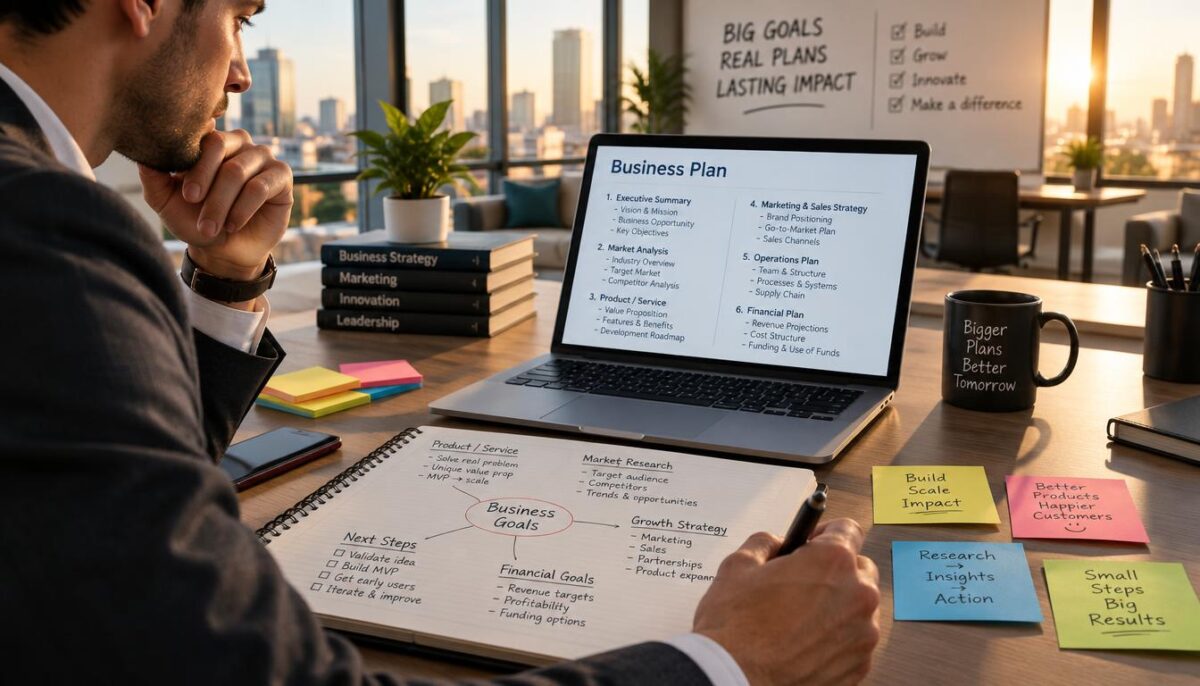
A business plan outline template gives you a structured way to turn an idea into goals, research, operations, and financial estimates. A lean startup plan is a concise business plan format that summarizes the key elements of a company, its customers, and its finances.
Use the outline as a starting point, then shape it around your company’s purpose. You may need a working document for internal planning, or a clear request for capital from a lender or investor. Your experience and available time can guide how much detail you add.
You’ll find a copyable structure and a clearly labeled hypothetical example. First, choose a plan format, then build and fill in the sections that fit your business.
Key Takeaways
- Choose a plan format based on who will read it and why.
- Use current research to support claims about customers and competitors.
- Connect daily operations to staffing and expense estimates.
- Label forecasts as estimates and state the assumptions behind them.
- Update the plan when customer needs, costs, or goals change.
Should You Choose a Traditional or Lean Business Plan?
Choose between the two formats based on how much detail your reader or decision-maker needs. A traditional business plan gives a full account of the company, while a lean startup plan presents its key points in brief.
Traditional plans take more work upfront and may run dozens of pages; lean plans typically fit on one page. Lenders and investors commonly request traditional plans, though each may have different needs. Some ask for more detail than a one-page plan provides.
Match the plan’s detail to the reader’s needs. A one-page summary may not give a lender enough information.
Choose a traditional business plan if you need a detailed planning tool or are preparing for traditional financing. That format gives you room to explain the business, market, operations, and financial forecasts.
A lean startup plan can help you communicate a simple idea quickly and revise it often. It can take as little as one hour to prepare, though that estimate depends on how much research you have done.
Neither business plan format works for every situation. A small business preparing to apply for a loan should ask the specific lender what it wants. Investors may also request details that do not fit on one page.
| Decision factor | Traditional business plan | Lean startup plan |
|---|---|---|
| Typical length | Dozens of pages | Typically one page |
| Drafting effort | More work upfront | Can take as little as one hour |
| Best fit | Detailed planning or traditional financing | Simple concepts or frequent revisions |
Once you choose a format, follow a practical drafting sequence. That sequence helps you move from basic research to a usable business plan without writing every detail at once.
How to Use a Business Plan Outline Template
Start by deciding who will use the plan and what decision it should support. A clear purpose helps you choose the right business plan template and avoid filling pages with information that readers do not need.
Build the plan in stages, then check that each section supports the same business idea. Research can change your offer or cost estimates, so leave room to revise the draft as you learn.
A seven-step drafting sequence
Use this sequence to get started. First, choose the plan’s purpose and format. Next, research the market and define the offer and target customer.
Then map management and operations, including who handles each task. Plan marketing and sales around how customers find and buy the offer. Estimate expenses and capital needs, then build financial projections and review the draft.
Keep a note of open questions while you work. For example, mark an estimated delivery cost as unconfirmed until you have a supplier quote. That makes guesses easier to spot later.
Copyable outline to fill in
Paste this plan template into Word or another editor, then add or remove detail to suit your needs. A business plan outline template free download can be convenient, but check that you can edit it before relying on it.
- Executive summary and company description
- Products, services, and market analysis
- Marketing and sales
- Management and operations
- Startup expenses, funding, financial projections, and appendix
The outline is a frame, not a finished plan. Add company-specific facts, customer needs, and evidence about the offer so each entry answers a real business question.
A separate guide to questions to answer when starting a new business can help you test whether the idea has a clear audience and path to revenue.
Move from the blank structure to the details of your company and offer. Those details give the plan its purpose and make each section useful.
What Should Your Executive Summary and Company Description Say?
A hypothetical summary sentence could read: “An online bakery sells custom celebration cakes and everyday treats to busy local households.” That first line names the offer and intended customers without claiming results.
The executive summary should give readers the company’s purpose, offer, goals, leadership, location, and high-level growth direction. Draft it after the other sections, even though it appears first in the finished business plan.
Summarize the business and its goals
Explain the problem the company aims to solve and how its products or services address it. State the mission and near-term goals in plain terms, such as opening a sales channel or serving a defined group of customers.
Include the company’s location and the leaders responsible for carrying out the plan. A reader should understand what the business does and what direction it intends to take without searching through later pages.
Keep the summary brief and factual. Avoid claims such as “the best in town” unless you can define and support them. A focused vision is more useful than a broad promise.
Explain the company’s structure and advantage
Describe the company’s origin when it helps explain its purpose. Name its owners and legal structure, and say where it operates. Common structures have different rules, costs, and risks.
Possible strengths include a useful location, a specialized skill, a reliable supplier, or an easier way to place an order. Explain how each strength helps the target customer, and do not claim an advantage you cannot support.
In the United States, common legal structures include sole proprietorships, partnerships, LLCs, and corporations. Learn about formalizing a business and choosing its legal structure before describing your setup.
The company description gives the offer a clear home. Next, show what customers receive and what market evidence supports the business idea.
How Do You Explain Your Offer and Market?
A feature describes what a product has; customer value explains the problem it helps solve. For example, an online ordering system may let a customer schedule a cake pickup without calling during business hours.
Describe the offer in terms of its features, customer benefits, and the evidence behind demand. Use current primary sources and your own research to check claims about the industry, target market, and competitors.
Describe products and services through customer value
Explain what you sell, what each item includes, and who may find it useful. For a service, describe what the customer receives and how the work is done. For products, note materials, sizes, delivery, or other features that affect use.
Describe how you source or make the offer, and how it may change over time. Include plans for research and development or intellectual property when they matter to the business.
Show how a product or service meets a customer need, rather than listing features alone. A clear description helps readers understand why someone might choose it over another option.
Research the target market and competitors
Study industry conditions, demand, and the people your company aims to serve. Look at direct competitors offering a similar product and indirect alternatives that solve the same problem in another way.
Compare competitors’ offers, prices, service, and gaps through your own research. Current company websites, public records, and customer interviews can provide useful details. Do not treat an old estimate or a broad industry claim as proof of local demand.
A SWOT analysis lists strengths, weaknesses, opportunities, and threats. Strengths and weaknesses are internal; opportunities and threats come from outside the company. Use the exercise to separate what your team can change from conditions it must respond to.
The examples below are hypothetical prompts, not findings about any local market. Replace every entry with local research before using the comparison in your plan.
| Alternative | Typical customer | What it offers | Potential gap to investigate |
|---|---|---|---|
| Independent neighborhood bakery | Nearby residents | Fresh baked goods and custom orders | Ordering hours or delivery choices |
| Grocery-store bakery | Shoppers seeking convenience | Packaged goods and standard cakes | Custom design or order timing |
| Home baking | People who bake for themselves | Control over ingredients and timing | Time, tools, or baking skill |
Use what you learn to make choices about pricing, promotion, and how to turn interest into sales. Those choices should fit the customer and the alternatives they can already use.
A practical set of startup questions about audience, competition, and revenue can help guide early market research.
How Will You Attract Customers and Make Sales?
A customer might hear about a repair service from a neighbor, visit its website, and book a time online. That path shows how a company can connect discovery to a sale.
Choose marketing channels based on customer behavior, the offer, your budget, and your ability to measure results. No channel guarantees that customers will buy, so track which efforts lead to useful conversations and sales.

Choose channels that fit the target customer
Describe how a customer may first hear about the business, learn what it offers, and decide whether to buy. Search visibility can help people find a service, while local outreach may work better for an offer people prefer to see in person.
Select a mix that you can maintain. A small business with limited staff may choose two channels and track them well, rather than trying every form of marketing at once.
- Digital content and search
- Email and social media
- Referrals and strategic partnerships
- Local outreach and in-person events
Use the list as a set of options, not a required checklist. Your marketing strategy should match the way customers look for the product or service and the time you can spend on outreach.
Explain pricing, sales, and retention
Set prices with the target customer, costs, and competitor offers in mind. Explain what a customer pays for and how the business handles questions, orders, payment, and delivery.
Describe the steps from first contact to purchase, then explain how you may earn repeat business. For example, a company could ask customers for feedback after an order and share an email offer for a later purchase.
Track results that fit each channel, such as inquiries, booked appointments, orders, or repeat purchases. Use those measures to decide whether to keep a channel, change its message, or test another approach.
A customer-facing strategy depends on people and daily work behind the scenes. The next part of the plan explains who will deliver the offer and how.
Who Runs the Business and How Will It Operate?
In a small company, one person may handle sales while another manages fulfillment, though roles can overlap. Clear responsibility helps the team avoid missed orders and unanswered customer questions.
Show who makes key decisions and how the business completes its daily work. A simple management chart can name each role, its main tasks, and who steps in when someone is unavailable.
Assign management roles and responsibilities
Describe the owners, managers, and staff, then connect each person’s skills and experience to their work. Note staffing needs as the business grows. If a contractor or supplier handles a key task, include that role too.
Explain who tracks income and expenses, places orders, checks inventory, and approves spending. A clear process for these tasks can help the team spot missing records or supplies before they cause delays.
Common legal structures include sole proprietorships, general or limited partnerships, LLCs, and C or S corporations. Legal and tax consequences vary. Check your structure and duties with a qualified professional or the relevant government office.
Map the day-to-day workflow
Describe how a customer order moves through production or service delivery. Name suppliers and subcontractors, and explain how the business checks quality. Include inventory steps when products or materials need storage.
For a service company, show how staff schedule, prepare, complete, and record each job. For a product business, describe how items are made, packed, and sent to customers.
An appendix can hold contracts, leases, purchase orders, intellectual-property documents, market research, and key managers’ resumes. Attach only records that help a reader understand the business or confirm a key point.
The operating model shapes staffing and expense assumptions. Use its workflow to estimate what the company needs before building the financial plan.
How Do You Estimate Startup Expenses and Funding Needs?
A cost estimate should cover expenses before revenue becomes dependable, not just opening-day purchases. Working cash matters because rent, payroll, and other bills may come due before sales cover them.
Separate one-time startup costs from recurring expenses, then estimate how much capital the business needs. Costs can include equipment, inventory or materials, setup and legal fees, marketing, payroll, and cash for operating bills.
Build a startup-expense and capitalization estimate
List each cost, its expected amount, and when you must pay it. Include deposits and costs that arise before launch, such as rent or payroll. Keep a separate list of recurring expenses so you can see what the business must cover each month.
Estimate starting cash from the timing of expected bills and cash receipts. A useful guide to startup costs and starting cash explains how pre-launch expenses and cash-flow timing shape the amount a business may need.
Use this checklist to build a first estimate. Replace rough guesses with quotes or other evidence as you gather it.
- Equipment
- Inventory and materials
- Setup and professional fees
- Launch marketing
- Payroll and operating bills
Review the list for costs that are easy to miss, such as delivery supplies, software, or a utility deposit. Keep those estimates tied to a clear reason, not a round number chosen to make the plan look complete.
Make a specific funding request
State the amount you need, the period it will cover, and how you will use the money. A request can explain how much capital is needed over the next five years for equipment, materials, salaries, or bills before revenue increases.
Name your preferred debt or equity financing and the terms you are asking for. Final terms depend on the financing arrangement, and lender requirements vary. Check the specific lender’s current requirements before preparing an application.
Explain how the company expects to meet repayments when it seeks debt. If more capital may be needed later, describe the reason. A plan may also name a strategic sale or another exit path when relevant.
Connect the funding request to forecasts that show whether the business can cover costs and obligations. Those forecasts should use the same sales and expense assumptions as the rest of the plan.
What Financial Projections Should the Plan Include?
A useful forecast connects expected sales to the timing of costs and cash receipts. That timing can matter as much as profit, since bills may arrive before customers pay.
Show the assumptions behind each forecast, and match the numbers to your sales plan and funding request. Financial projections are estimates, not promises of future results.
Show the financial statements and their assumptions
Build revenue estimates from expected sales volume and prices. Estimate expenses from staffing, supplies, rent, and other operating needs. State how you set each figure, such as using a supplier quote or a planned number of orders.
Project profit, cash flow, assets, liabilities, and capital spending. A balance sheet shows what the business owns and owes at a point in time. A cash-flow statement tracks money moving in and out across a period.
Established businesses can include income statements, balance sheets, and cash-flow statements for the last three to five years. Forward-looking projections commonly cover five years, with monthly or quarterly detail for the first year.
| Statement or forecast | Main question answered | Useful inputs |
|---|---|---|
| Income statement | Does revenue exceed expenses? | Sales, costs, and operating expenses |
| Balance sheet | What does the business own and owe? | Assets, liabilities, and owner equity |
| Cash-flow statement | When does cash enter or leave? | Cash receipts, bill timing, and payments |
Use realistic assumptions and keep them consistent across the statements. If sales depend on a new product, state the expected launch timing and order volume behind that estimate.
Forecast cash needs, results, and break-even
Compare expected cash receipts with payments due each month or quarter. This can reveal a cash shortfall even when projected sales exceed expenses over a full year.
The break-even point is when revenue equals total costs. Test how many sales the business may need to reach it, using your expected price and cost per sale. If costs rise or sales slow, recalculate the estimate.
Review whether projected revenue can support payroll, supplier bills, debt payments, and other obligations. A forecast helps you spot risks and adjust a plan, but actual results can differ from estimates.
With the forecasts in place, a compact example can show how a company’s customer, operations, strategy, and numbers fit together.
What Does a Completed Business Plan Example Look Like?
A fictional neighborhood online bakery serves customers who want convenient orders for celebration cakes and everyday baked goods. Its promise is simple: order online, choose a pickup or delivery time, and get baked goods made to order.
Every bakery detail and figure below is hypothetical and illustrative, not evidence of real performance. Treat the forecasts as assumptions to test, not as results or promises.
The bakery’s target customer is a local household planning a celebration or seeking treats for home. Its founder would research nearby bakeries, grocery-store bakeries, and home baking before claiming a market gap.
Illustrative forecasts are assumptions to test, not proof that a business will earn those results.
Set up a hypothetical neighborhood bakery
In this example, customers place orders through a website. The bakery prepares each order, packs it, and arranges pickup or local delivery. Its promotion plan might use local search, social media, referrals, and partnerships.
The founder handles ordering and customer questions, while a part-time baker prepares products during busy periods. The founder would track costs, check order quality, and review customer feedback.
Show how the strategy and numbers connect
The hypothetical startup cost estimate is $15,000. The example funds it with $10,000 in owner capital and a $5,000 loan. It assigns the money to equipment, ingredients, packaging, and initial operating needs.
The hypothetical first-year forecast shows $120,000 in sales, $42,000 for ingredients and packaging, and $60,000 in other operating expenses. That leaves $18,000 in operating profit before taxes and debt service.
These figures are illustrative forecasts, not actual company results. They depend on assumptions about orders, prices, costs, and timing. Business plan examples for students can show structure, but students should follow assignment rules and label invented scenarios.
Before committing more money, the founder should validate the expected number of paid orders from local customers.
Conclusion
A useful plan is specific enough to guide your next decision and flexible enough to update. It should fit your business and the reader’s purpose, not follow a fixed format for its own sake.
Check key assumptions as the company learns. New customer feedback, cost changes, or shifts in financial goals may call for a revised forecast or a different plan.
To get started, copy the outline into a working document and fill in your target customer and first cost assumptions. Then mark which estimates still need evidence.
FAQ
How to write out a business plan template?
Choose the plan’s purpose, then fill in each relevant section with information specific to your company. Use research and records to support claims about customers, costs, and operations. Write the executive summary after the other sections, so it reflects the finished draft. Review the full plan for gaps, conflicting figures, and assumptions that need checking.
What is a SWOT analysis in a business plan?
A SWOT analysis lists strengths, weaknesses, opportunities, and threats. Strengths and weaknesses describe internal skills, resources, or limits that the company can influence. Opportunities and threats describe outside conditions, such as customer demand or new competition. Use the four groups to separate what the team can change from risks it must plan around.
What are the 7 steps to create a business plan?
The seven steps are: choose the purpose and format, research the market, define the offer and target customer, map operations, plan marketing and sales, estimate costs and funding, and prepare and review projections. The order helps you build from the customer and business idea toward the numbers. Revisit earlier choices if later research changes your assumptions.
How often should I update my business plan?
Review your plan whenever a major assumption changes. A launch, new offer, market shift, or change in financial goals can affect your costs, sales, or staffing needs. You can also set regular review times that fit your business. Update the sections affected by new information, then check that the financial forecasts still match the operating plan.
Should a one-page lean plan be enough to apply for a loan?
A one-page lean plan may not be enough to apply for a loan. Some lenders ask for more detail or supporting documents, and requirements differ by lender and loan. Confirm the requested format with the specific lender before preparing your application. If needed, expand the plan with operations, market research, financial forecasts, and other requested information.