When executive boards approve the IT budget, there is often a dangerous assumption that paying for antivirus software and a commercial-grade firewall equates to a secure digital environment. For decades, this perimeter-based approach was the corporate standard. The operational theory was simple: build a strong digital wall around the corporate network, install scanners at the entry points, and assume everything operating inside the wall is safe.
Modern cybercrime has completely dismantled that theory. Organized threat syndicates no longer waste resources attempting to brute-force their way through a hardened firewall. Instead, they exploit human psychology, hijack active sessions, and leverage unpatched third-party software to bypass the perimeter entirely. Relying on basic, single-point security tools creates a fragile operational environment where a single compromised password or a misconfigured cloud bucket can lead directly to total network encryption and massive balance sheet destruction.
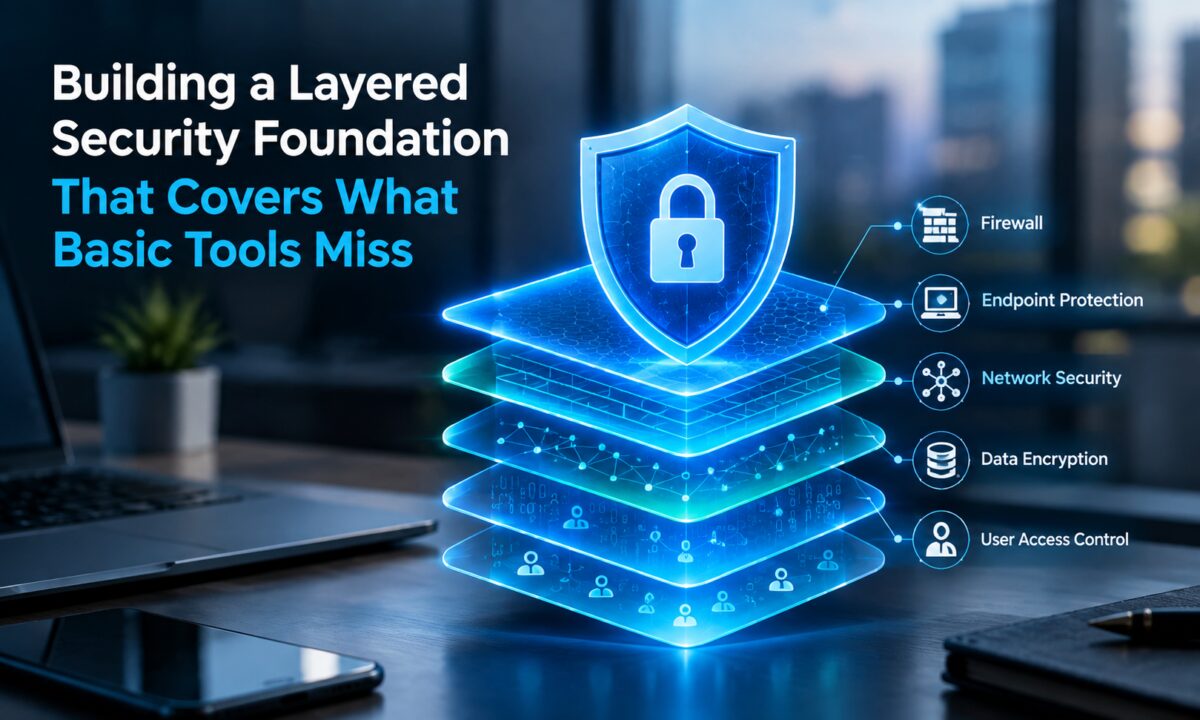
Protecting corporate capital in the current threat landscape requires adopting a layered security architecture—often referred to as defense in depth. This strategy operates on the assumption that a breach will eventually occur. By implementing multiple, overlapping security controls, an organization ensures that if one defensive layer fails, the next layer instantly steps in to contain the threat, limiting the exposure of proprietary data and preventing a localized incident from escalating into a catastrophic operational failure.
The Financial Illusion of Single-Point Defenses
Basic security tools are designed to stop known, recognizable threats. Standard antivirus software relies on signature-based detection, meaning it scans incoming files against a known database of malicious code. If the file matches a signature on the list, the software blocks it.
The flaw in this model is that modern threat actors constantly alter their code. A slight modification to a ransomware script changes its digital signature entirely, rendering it completely invisible to legacy antivirus scanners. Furthermore, advanced persistent threat (APT) groups frequently utilize “living off the land” techniques. Rather than downloading malicious software onto a target machine, they manipulate the native, legitimate administrative tools already built into the operating system—such as PowerShell or Windows Management Instrumentation. Because no external malicious file is introduced, standard security tools see nothing wrong and remain completely silent while the network is quietly mapped and compromised.
For an executive leadership team, relying on static, single-point defenses is a failure of risk management. When a defense strategy hinges entirely on a single software application keeping attackers out, the organization carries an unacceptable level of operational liability. A layered foundation strips away this vulnerability by distributing risk across network controls, endpoint telemetry, identity verification, and human behavioral training.
Moving Beyond the Perimeter: Identity as the New Defense Line
The rapid adoption of hybrid work models, mobile devices, and decentralized public cloud infrastructure has effectively erased the traditional corporate network perimeter. Employees now access sensitive corporate databases from home internet connections, coffee shop Wi-Fi networks, and personal mobile devices. You can no longer build a wall around your data because your data no longer resides in a single, physical location.
In a decentralized environment, user identity becomes the primary defensive boundary. A layered security foundation mandates the implementation of Zero Trust architecture. In a Zero Trust framework, the network inherently distrusts every user, device, and application—even if they are already operating inside the corporate environment. Every single request to access a specific file, database, or cloud application must be continuously authenticated, authorized, and validated against strict access policies.
The National Institute of Standards and Technology provides highly specific architectural blueprints for establishing this identity-first defense. Within the NIST Special Publication 800-207 on Zero Trust Architecture, federal security experts emphasize that trust is never granted implicitly based on physical or network location. Organizations must enforce strict access controls based on real-time risk assessments, ensuring that an employee’s compromised credentials cannot be used to move laterally across the network and access restricted financial or operational data.
Multi-factor authentication (MFA) is the baseline requirement for securing this identity layer, but basic SMS-based MFA is no longer sufficient. Advanced threat actors routinely execute SIM-swapping attacks or deploy adversary-in-the-middle (AiTM) phishing kits to intercept text message passcodes. A robust layered defense requires deploying hardware-based security keys or biometric authentication protocols that are strictly resistant to remote interception.
Replacing Static Scanners with Behavioral Telemetry
Since threat actors can bypass traditional antivirus tools by altering file signatures or executing fileless malware directly in system memory, organizations must upgrade their endpoint defenses to focus on behavior rather than static code.
Endpoint Detection and Response (EDR) and Extended Detection and Response (XDR) platforms form the critical telemetry layer of a modern defense strategy. These tools continuously monitor raw system events across all corporate devices in real time. They track process execution, memory allocation, registry modifications, and outbound network traffic.
By establishing an objective baseline of normal operational behavior, an EDR platform can instantly flag anomalous activity. If an accounting workstation that normally only accesses payroll software suddenly attempts to run a PowerShell script to query the Active Directory, the EDR system does not wait for a known malware signature. It recognizes the behavior as hostile, automatically isolates the compromised machine from the local network, and blocks the process execution in milliseconds.
This shift from reactive scanning to active behavioral monitoring is non-negotiable for mitigating modern ransomware deployment. Threat actors rely on speed once they initiate their encryption routines; deploying automated telemetry ensures that malicious behavior is interrupted before it can paralyze the physical infrastructure of the business.
Auditing the Blind Spot of Third-Party Risk
A layered security foundation must extend beyond the walls of your own organization. Commercial enterprises rely on a vast network of third-party vendors, suppliers, and software providers to maintain daily operations. Your internal network might be fortified with the strictest access controls and advanced telemetry, but if your HVAC vendor, legal counsel, or logistics software provider maintains direct access to your network and suffers a breach, their vulnerability immediately becomes your liability.
Supply chain attacks allow cybercriminals to compromise a single, weakly defended vendor and use that trusted connection to infiltrate dozens of highly secure enterprise targets downstream. Managing this specific risk requires establishing a dedicated third-party risk management (TPRM) protocol within your layered defense strategy.
The Cybersecurity and Infrastructure Security Agency heavily scrutinizes the systemic risk posed by unmonitored vendor access. In their detailed analytical framework, Defending Against Software Supply Chain Attacks, CISA explicitly outlines the necessity of strictly verifying the security posture of external partners. The guidelines mandate that organizations apply the principle of least privilege to all vendor accounts, isolating third-party access into segmented network zones and continuously monitoring those connections for unauthorized lateral movement.
Corporate leadership must demand objective proof of security from their vendors, enforcing contractual requirements for regular penetration testing and strict incident disclosure timelines before granting them access to proprietary data environments.
The Financial Weight of Incident Response Planning
The final, and arguably most critical, layer of a layered security foundation is the assumption of failure. No combination of firewalls, MFA protocols, or behavioral detection algorithms can guarantee absolute protection against a highly motivated, state-sponsored threat actor or a malicious internal employee. When a breach inevitably occurs, the difference between a minor operational disruption and a devastating extinction event is determined entirely by the speed and precision of the organization’s incident response.
Executive boards frequently view incident response planning as a theoretical IT exercise. In reality, it is a strict corporate governance requirement designed to preserve capital and limit legal exposure during a crisis. A documented incident response plan dictates exactly how the organization will isolate compromised systems, communicate with regulatory bodies, engage external legal counsel, and restore backups without triggering secondary extortion events.
The legal and regulatory pressure to maintain these active response protocols has escalated sharply. The Securities and Exchange Commission now holds corporate leadership directly accountable for their digital risk management processes. Under the SEC Final Rule on Cybersecurity Risk Management, Strategy, Governance, and Incident Disclosure, public companies are required to disclose material cybersecurity incidents within four business days. This severe reporting timeline means that an organization cannot wait until a breach occurs to figure out how to investigate it. They must possess the structural capability to rapidly assess the scope, financial impact, and legal materiality of an intrusion the moment it happens.
Building this capability requires conducting aggressive, regular tabletop exercises that force executive leadership, legal teams, and IT directors to practice their specific roles during a simulated ransomware deployment. Testing the response plan under pressure exposes critical communication gaps and technical bottlenecks, allowing the business to fix them before real capital is on the line.
Establishing Structural Resilience in Regional Markets
Implementing a defense-in-depth architecture is a highly complex engineering challenge that requires continuous oversight, tuning, and strategic alignment with business objectives. Mid-market enterprises frequently lack the internal headcount to operate a 24/7 Security Operations Center (SOC) or deploy dedicated threat hunters to monitor behavioral telemetry.
Relying on a fragmented IT team to manage advanced security tools inevitably leads to alert fatigue, where critical warning signs are ignored because the system generates too much noise. For mid-market enterprises expanding operations, investing in robust cybersecurity for Charlotte businesses means moving past off-the-shelf software and building a customized, layered defense architecture supported by dedicated external expertise. Engaging specialized technical oversight ensures that EDR platforms are actively monitored, network segmentation is rigorously enforced, and vendor risk is continuously audited without burning out internal administrative staff.
Protecting your enterprise from modern extortion is an ongoing operational discipline. By abandoning the illusion of single-point defenses, enforcing strict identity validation, deploying behavioral analytics, and preparing aggressively for the inevitable breach, executive leaders construct a resilient digital infrastructure. A layered security foundation does not just block malicious code; it actively protects the corporate balance sheet, mitigates legal liability, and secures the long-term equity of the business.