

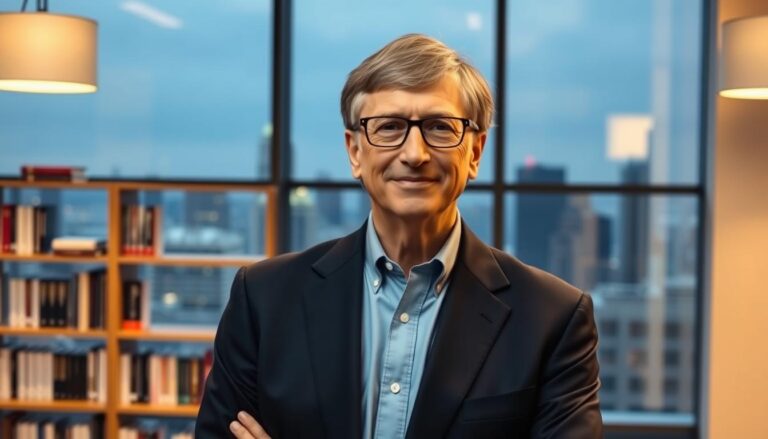
William Henry Gates III rose from Seattle schoolrooms to shape the personal computer era. He left Harvard University to pursue a vision that began with coding and grew into a global software company founded with paul allen in 1975.
His focus moved from hands-on development to strategy for the operating system that powered millions of computers worldwide. Over the years he shifted roles: CEO, chief architect, then a long-term technology advisor, while also building ventures in energy, health, and investment.
Financial milestones marked his path: the youngest billionaire in 1987 and the first centibillionaire in 1999. As of May 2025 his net worth is estimated at $115.1 billion, yet his later years emphasize philanthropy through a major foundation and new companies.
This introduction previews a friendly, factual biography: family and school roots, pivotal software and system breakthroughs, the move from entrepreneur to philanthropist, and awards that reflect global impact.
Key Takeaways
- Early Seattle roots and a Harvard decision launched a transformative tech career.
- Partnership with paul allen began a company that reshaped software and systems.
- He moved from coding into operating system strategy and long-term technology vision.
- Major wealth milestones did not stop a clear shift toward large-scale philanthropy.
- Today he leads a renamed foundation and several ventures that extend his influence.
From Seattle prodigy to tech icon: the arc of Bill Gates’s biography
A Seattle childhood and a Lakeside classroom terminal introduced him to computers at 13, igniting an enduring curiosity.
Born in 1955 in the united states, he found a rigorous school environment that fostered early interest in math and machines. That age-13 encounter with a computer changed his path toward programming and problem solving.
He enrolled at harvard university in 1973, taking intense courses such as Math 55 and graduate computer science. After two years, he left to build a company with paul allen, focusing on software that would reshape the world.
The startup grew fast. In the 1980s and early 1990s those years of rapid expansion turned a small team into a leader in personal computing. An IPO in 1986 and billionaire status in 1987 marked major business milestones.
Over time his role moved from hands-on coding to strategic leadership. He shifted from CEO in 2000 to chief software architect, then toward full-time philanthropy, keeping education and technology at the heart of his public life.
Family roots and childhood influences that shaped Bill Gates
A household that prized achievement and debate set the tone for his early drive and curiosity. His parents modeled public service and professional success, and that atmosphere made ambition feel normal.
At home in Seattle, William H. Gates Sr. worked as a lawyer while Mary Maxwell Gates served on civic boards. The family encouraged schooling and friendly rivalry with his two sisters.
At Lakeside School he first met a friend, paul allen, and found the computer room. That early interest led him to ask questions, tinker with terminals, and join peers who loved puzzles.
The Lakeside Programmers Club—alongside paul allen, Ric Weiland, and Kent Evans—offered time and access to shared projects. Those collaborations sharpened problem solving and teamwork skills.
These early lessons in competition and collaboration seeded a mindset that later drove software advances and shaped a leadership style with global reach.
| Influence | Example | Later Impact |
|---|---|---|
| Family | High expectations, civic service | Ambition and public-minded projects |
| School | Lakeside, access to terminals | Technical curiosity and early coding |
| Friends | paul allen and club partners | Teamwork that fueled company culture |
For personal perspective and inspirational quotes, readers can explore reflections that echo these formative years.
Lakeside School: the spark of computing and programming passion
A single classroom purchase at Lakeside opened a new world of computing for a group of curious teens. The Mothers’ Club bought a Teletype Model 33 ASR, and that terminal connected students to a GE mainframe for scheduled program time.
The Teletype terminal, GE mainframe time, and BASIC
Early access to BASIC on the GE mainframe gave practical training in logic and problem solving. One student wrote a tic-tac-toe program and then explored Fortran, Lisp, and machine language.
Those hours taught how a language maps to a system. They also made programming feel useful and fun.
Lakeside Programmers Club, CCC access, and early projects
Students formed the Lakeside Programmers Club with paul allen, Ric Weiland, and Kent Evans. The club traded bug reports for extra PDP‑10 minutes at the Computer Center Corporation (CCC).
They built tools such as a class‑scheduling program after Kent’s death. That real project moved them from study to real-world development and teamwork.
Why it mattered
- Access to terminals seeded long-term interest and practical skill.
- Collaboration with paul allen shaped a pragmatic approach to software.
- Hands-on projects formed a foundation for later language interpreters and systems.
| Resource | Activity | Impact |
|---|---|---|
| Teletype Model 33 ASR | Connected to GE mainframe | Introduced BASIC and timed computing access |
| PDP-10 at CCC | Studied system code and reported bugs | Earned computer time and deeper system knowledge |
| Lakeside Programmers Club | Group projects and scheduling tool | Shifted learning toward real software development |
Harvard University years: math, computer science, and a pivotal choice
Inside crowded lecture halls and late-night labs, he turned abstract problems into fast solutions. Enrolling in 1973 meant tackling Math 55 and graduate-level computer science courses that sharpened logic and rigor.
Math 55 and advanced CS pushed an analytical mindset. These classes gave confidence to solve tough algorithmic challenges and write clear, efficient code.
From rigorous theory to a record algorithm
During these years he devised a record-fast pancake sorting program. That work later became a formal paper coauthored with Christos Papadimitriou, signaling early research-level achievement.
This mix of theory and practical system thinking foreshadowed choices about operating system design and platform strategy. Conversations with paul allen and the arrival of the Altair 8800 shifted priorities.
By 1975 the decision to leave Harvard was about moving from elite education to hands-on development and entrepreneurship. Those years cemented a pattern: see an opportunity, act decisively, and build.
| Aspect | Harvard Influence | Later Impact |
|---|---|---|
| Courses | Math 55, grad CS | Analytical rigor for software development |
| Research | Pancake sorting publication | Proof-of-concept for algorithmic thinking |
| Network | Peers and mentors, conversations with paul allen | Move to entrepreneurial software work |
For perspective on that departure and its context, see this profile of the Harvard years.
Bill Gates – Co-founder, Microsoft
In 1975, a leap from student projects to a small Albuquerque office launched a software-first venture. That initial product, Altair BASIC, showed how code could make a hobbyist computer actually useful.
The founders—one a college dropout and the other a longtime collaborator, paul allen—named the effort Micro-Soft and focused on tools that unlocked early personal computers. Their early work prioritized usable interpreters and compilers over hardware.
By June 25, 1981 the firm incorporated in Washington state. Leadership roles settled: the company named bill gates president and chairman, with allen as vice chairman.
Over the following years the business evolved from hands-on coding to system-level strategy. Decisions about the operating system and partner ecosystem turned a small team into a global platform vendor.
| Year | Milestone | Impact |
|---|---|---|
| 1975 | Altair BASIC launch | Proved software could add value to personal computers |
| 1981 | Incorporation in Washington | Formalized company structure and leadership roles |
| 2000–2008 | Leadership shift | From CEO to chief software architect, guiding platform strategy |
Technology choices during these formative years helped the company underpin the PC boom. By building partners and a broad developer network, they made software the central asset that powered the modern world.
Founding Microsoft with Paul Allen: vision, grit, and early code
Two friends in a small Albuquerque room turned a risky idea into a runnable interpreter that proved microcomputers could do serious work.
Altair BASIC and the Albuquerque beginnings
In 1975, bill gates and paul allen built an Altair emulator and a BASIC interpreter fast enough to secure a deal with MITS. That quick proof of product-market fit showed that the right program could make a hobbyist computer useful for real tasks.
“An Open Letter to Hobbyists” and the case for software value
The 1976 letter argued that copying unpaid software harmed professional development. It framed software as intellectual work that deserved compensation so businesses could invest in better products.
From Micro-Soft to Microsoft: team, incorporation, and growth
The firm registered its name in 1976 and kept evolving. Early hires, including Ric Weiland, set a culture of rapid development and practical design.
- Move to Bellevue in 1979 brought the team back toward Seattle and a growing partner network.
- Early design choices—portable interpreters and modular code—later influenced larger system strategy.
| Year | Event | Impact |
|---|---|---|
| 1975 | Altair BASIC release | Proved market demand for professional software |
| 1976 | Open Letter published | Defended software value and business model |
| 1979 | Relocated to Bellevue | Expanded partnerships and hiring cadence |
The IBM partnership and MS‑DOS: the operating system that scaled the PC
When IBM moved toward a personal computer in 1980, the team saw a rare opening to shape the platform that would follow.
Quick work and clear strategy turned an acquisition of 86‑DOS into a defining product. After IBM’s talks with Digital Research faltered, the company adapted the code and delivered PC DOS for $50,000 while keeping broader rights as MS‑DOS.
Negotiating PC DOS and retaining wider rights
The choice to retain licensing rights let the company sell the operating system to makers beyond IBM. That move made MS‑DOS a licensable platform, not an IBM-only asset.
De facto standard and market impact
Over the years, MS‑DOS became the trusted system for an expanding IBM-compatible market. Partners and developers built on a consistent base, and the company’s reputation rose fast.
- bill gates and the leadership team recognized the scale of IBM’s launch.
- paul allen helped steer negotiations and product direction during that crucial year.
- The operating system became a cornerstone that set a standard for PC software and hardware vendors.
| Event | Action | Impact |
|---|---|---|
| 1980 IBM approach | Adapt 86‑DOS, deliver PC DOS | Immediate market access and credibility |
| Contract terms | Retain wider licensing rights | Allowed MS‑DOS to spread to many vendors |
| Market result | MS‑DOS becomes default | Company reputation and industry leadership grew |
Windows era: GUI innovation and the personal computer revolution
The move from text commands to windows and icons changed everyday computing for offices and homes.
From early GUIs to a mainstream platform
Windows 1.0 arrived in 1985 as a first step toward a graphic interface layered on an existing operating system.
Over the years, releases culminated in Windows 95’s breakout ease of use and the long-lived stability of Windows XP in 2001.
XP followed Gates stepping down as CEO, while he stayed on as chief software architect to guide core design decisions.
OS/2 tensions and a strategic pivot
Collaboration with IBM on OS/2 in the mid‑1980s strained as priorities diverged.
The company chose to prioritize a self-directed Windows roadmap to protect portability and control.
That pivot helped Windows become the default platform for many PC makers and developers.
“Backward compatibility and partner support turned Windows into a platform where third-party programs thrived.”
Design choices emphasized stability, ease of use, and a predictable API for developers.
Programs like Office aligned tightly with Windows to add value for work and home computers.
| Milestone | Year | Impact |
|---|---|---|
| Windows 1.0 | 1985 | Introduced GUI layer for PCs |
| Windows 95 | 1995 | Mass adoption, plug-and-play, Start menu |
| Windows XP | 2001 | Stability and long-term enterprise support |
- Daily engineering work focused on usability, stability, and partner support.
- Backward compatibility allowed older programs to keep running.
- Leadership shifted but day-to-day technical calls still included bill gates guiding platform decisions.
Leadership, management style, and the evolution from coder to strategist
What began as daily code reviews evolved into a rhythm of system thinking and product roadmaps. In early years he frequently read and rewrote code, keeping tight control on technical quality.
Over time that approach moved toward high-level strategy. As CEO he set priorities that guided teams across the company.
His management prized technical depth, clear thinking, and measurable outcomes. Meetings focused on metrics, trade-offs, and fast feedback loops that improved product reliability.
He balanced product detail with scaling by delegating ownership and empowering engineers. That let the platform grow while preserving architectural intent.
- Shifted from hands‑on code to platform and product strategy over the years.
- Used sharp prioritization to align teams on key system goals.
- Moved through roles—coder, CEO, chief software architect, advisor—focusing later on long‑term projects.
“Prioritize ruthlessly and demand clear answers”
Wealth, net worth, and influence in the United States business landscape
An IPO in the 1980s began a trajectory that mixed rapid capital gains with broad investment and giving strategies.
bill gates became the world’s youngest billionaire in 1987 after the 1986 IPO. He later reached centibillionaire status in 1999 and topped global lists for many years.
Philanthropy changed the balance between private wealth and public impact. Large gifts to the foundation reduced immediate personal worth but expanded influence on global health and development.
Long-term diversification through Cascade Investment and stakes in other companies smoothed fluctuations in net worth and preserved operating freedom.
IPO to centibillionaire: milestones and philanthropy’s impact on wealth
Forbes ranked him the richest person for 18 of 24 years between 1995 and 2017. As of May 2025 his net worth is estimated at $115.1B, reflecting a mix of stock, investments, and gifts.
“Wealth can be a tool for large-scale public good.”
- Key milestones: 1986 IPO → 1987 billionaire → 1999 centibillionaire.
- Philanthropy and investments tempered short-term wealth but widened global reach.
- The united states corporate climate let a software-led company scale across the world.
At his current age, decades of leadership show a pattern: steward capital, run companies, and commit to public service. The 2018 death of paul allen marks an important note in that shared legacy.
Philanthropy and global health: the Gates Foundation’s mission and reach
He turned platform thinking into large-scale giving, creating a foundation that focuses on measurable outcomes and partnerships. The organization has become the world largest private philanthropy, funding programs in health, education, and poverty reduction.
Combating malaria, polio, and infectious diseases worldwide
The foundation concentrates on vaccine development, delivery systems, and surveillance for diseases such as malaria, polio, and tuberculosis.
Grants support research, local health systems, and mass immunization campaigns in low‑resource regions.
Education, poverty alleviation, and impact-driven grantmaking
In the united states and abroad, funding is data-driven: pilot programs, rigorous evaluation, and scale when outcomes show impact.
Efforts include school improvement, learning science, and cash‑transfer or market-based poverty programs aimed at measurable change.
The Giving Pledge and governance changes
He co-founded the Giving Pledge as a way for billionaires to commit most of their wealth to public good.
After 2024 governance updates, the renamed foundation placed him as sole chairman, emphasizing transparency and stronger impact metrics.
“Philanthropy should be measurable and built for the long term.”
- Mission: improve global health and reduce inequity.
- Approach: partnerships with public and private sectors, rigorous data, and long-horizon funding.
- Day-to-day: strategic oversight that reflects his age and long-range priorities.
Beyond Microsoft: TerraPower, Breakthrough Energy, Cascade Investment, and more
He pivoted toward funding bold engineering efforts aimed at lowering emissions and reshaping energy systems.
TerraPower leads advanced nuclear designs meant to be pragmatic decarbonization solutions. These projects aim to pair improved safety with scalable power systems and long development roadmaps.
Breakthrough Energy backs startups that reduce emissions worldwide. Its model funds high‑risk, high‑reward technology and then helps scale proof‑of‑concepts into commercial projects.
Venture building and capital stewardship
Cascade Investment manages capital to build resilient companies and preserve long‑term value. BENlabs and Gates Ventures support software‑enabled media and new product development with patient funding and product teams.
Advising and ecosystem influence
Since 2014 he serves as a technology advisor at the company under Satya Nadella, focusing on cloud and platform priorities. Alumni ties, including influences from paul allen, seed collaboration across labs and institutions.
“Development cycles balance risk with clear project roadmaps and strong partnerships.”
Public recognition and writings: honors, speeches, and books
Public honors and clear writing have broadened how the public understands tech, giving, and global policy.
Major honors and global accolades
Recognition spans decades and continents. Honors include Distinguished Fellow of the British Computer Society (1994), Padma Bhushan (2015), KBE (2005), Presidential Medal of Freedom (2016), Grand Cordon of the Order of the Rising Sun (2020), and Hilal-e-Pakistan (2022).
These awards reflect contributions to business, software, public health, and education across the world.
Books, speeches, and the 2025 memoir
Writings have mixed strategy and practical advice. Key titles include The Road Ahead, Business @ the Speed of Thought, How to Avoid a Climate Disaster, and How to Prevent the Next Pandemic.
Source Code: My Beginnings (2025) is a short memoir that revisits early education, first computer projects, and formative time at Lakeside and Harvard.
Speeches at venues like the World Economic Forum helped frame tech as a tool for public good and fostered policy conversations about innovation and public health.
- Accessible language: books and talks use plain language to reach a wide audience.
- Impact: honors underline the link between entrepreneurship, philanthropy, and sustained public engagement.
- Commitment: recognition ties back to ongoing work with the foundation and education initiatives.
| Year | Honor or Work | Focus |
|---|---|---|
| 1994 | Distinguished Fellow, British Computer Society | Contributions to computer science and industry |
| 2005 | KBE | International public service and philanthropy |
| 2016 | Presidential Medal of Freedom | National recognition for public impact |
| 2025 | Source Code: My Beginnings | Memoir on early coding, education, and career start |
For a deeper look at his life and impact, read the full biography.
Partnerships and friendships: Paul Allen’s enduring influence
A friendship forged over shared curiosity at Lakeside soon became a defining partnership in early personal computing.
bill gates and paul allen first bonded at school, where teamwork and late-night tinkering led to Traf-O-Data. That small company experiment taught practical engineering, product focus, and how to run a company.
From Traf-O-Data to lifelong collaboration and legacy giving
Traf-O-Data sharpened skills that mattered when they launched larger ventures. Even after early tensions and equity disputes, the pair repaired trust and rebuilt a strong personal bond.
Allen left day-to-day work in 1983 after a Hodgkin lymphoma diagnosis. Later, his institutions and legacy giving—plus a major donation to Lakeside—extended his influence beyond business.
“Their friend dynamic turned technical debates into shared vision.”
| Aspect | Example | Impact |
|---|---|---|
| School roots | Lakeside teamwork | Early collaboration habits |
| Formative project | Traf-O-Data | Built engineering and business instincts |
| Reconciliation | Donations and restored ties | Long-term respect and joint legacy |
| Life and loss | Allen’s death in 2018 | Marked end of a pioneering era |
Family, community, and that shared school background kept their aims aligned. Their friendship shaped problem-solving, product priorities, and a legacy that still matters today.
Views on technology, AI, and pandemic preparedness
He balances optimism about new tools with steady caution about long-term risks to society. That mix shows in talks, essays, and day-to-day public commentary.
On artificial intelligence he warns about both rapid progress and rare, extreme outcomes. In 2015 he recommended reading Nick Bostrom’s Superintelligence and later highlighted governance, testing, and safety research as practical steps.
Before COVID‑19 he used a TED talk to say the world was not ready for a major pandemic. That warning helped shape the foundation’s sharpened focus on preparedness and response systems.
Global health work now links surveillance, diagnostics, and supply chains so outbreaks are caught earlier and treated faster.
“Invest, test, and iterate — small experiments build resilient systems over time.”
Current projects bridge climate, diagnostics, and scalable response tools. The approach is straightforward: fund pilots, measure results, and scale what works.
- Balanced view on AI risks and long‑term oversight.
- Early calls for pandemic readiness that anticipated later crises.
- Practical projects that fuse technology with public good.
Enduring impact on software, entrepreneurship, and the world’s largest foundation
Decisions about system design and licensing shaped how millions used personal computers for decades. Early work on MS‑DOS and Windows set a de facto standard that made hardware and apps interoperable across the market.
Standardizing the PC era through operating systems and platforms
The operating system choice created a predictable base for developers and partners. That predictability let a small set of APIs and tools scale into a broad ecosystem.
By supporting third‑party developers and OEM partners, the company built a durable advantage. Software vendors found a reliable target, which sped up product development and adoption.
Setting a template for entrepreneur-led philanthropy at global scale
The foundation model combined scientific rigor, large projects, and cross‑sector partnerships. As sole chairman, bill gates shaped grantmaking that targets measurable outcomes in global health and education.
Meanwhile, paul allen’s institutes and ventures grew scientific and cultural infrastructure that complemented those efforts. Both paths show how entrepreneurship can fund long-term public projects.
| Area | Focus | Result |
|---|---|---|
| Platform | Compatibility and developer tools | Widespread software ecosystem |
| Philanthropy | Data-driven grants | Scaled global health programs |
| Legacy | Institutes and investments | Continued research and cultural support |
“Standard platforms and patient funding changed how both business and public projects scale.”
Conclusion
Curiosity and steady execution turned early computer experiments into practical software that reshaped the world. His life shows how focused work on simple problems can scale into systems that millions use today.
By May 2025 his net worth reflected decades of choices about product, investment, and giving; that financial worth sits alongside a uniquely American story of scaling from small teams in the united states. The public figure’s net worth is a marker, not the full measure of impact.
The foundation reframed purpose: it uses data and long horizons to turn funds into measurable health and education gains. Over time and years, this approach taught lessons about leadership, partnership, and practical problem solving.
At any age, experience can amplify impact. Take the view that technology is a tool: apply evidence, focus on outcomes, and use resources to do the most good for the world.