

America is committing billions of dollars to homelessness assistance, while policymakers continue to confront a basic information challenge: understanding precisely what is happening on the ground.
The scale of public investment illustrates the importance of that question. On June 1, 2026, the U.S. Department of Housing and Urban Development announced a $4.04 billion Continuum of Care funding opportunity, including $1.3 billion for new projects with priorities including transitional housing and supportive services. HUD’s 2026 Continuum of Care Notice of Funding Opportunity also points to a 27% increase in homelessness since 2013 alongside a doubling of funding.
That combination may invite a broader policy question: How precisely can communities determine where resources are needed, which conditions require attention, and whether interventions are reaching the people and places they are intended to serve?
Nikolas Cook, president of Unhoused Awareness, a Puget Sound-based 501(c)(3) nonprofit focused on data-driven advocacy and geospatial analysis, argues that the quality of those decisions depends heavily on the quality of the underlying information. “You can’t effectively solve a problem you cannot accurately see or measure,” Cook says. For him, visibility is a form of infrastructure.
Traditional homelessness counts can provide an important snapshot, yet a number on a spreadsheet may leave substantial context unexplained. A tent can represent different circumstances and occupancy levels. People may live beneath bridges, within dense vegetation, behind structures, or in other difficult-to-access locations where conventional canvassing can become challenging. Manual surveys can also place staff or volunteers in environments where safety and liability require careful consideration.
Cook’s perspective draws partly from experience in aerospace, where traceability, repeatable processes, and precise measurement are integral to complex systems. He sees an opportunity to apply some of that thinking to homelessness data. “If a policymaker receives a number, that number should have a physical reality behind it,” he states. “The closer we can connect the record to the environment that produced it, the more useful that record can become.”
That philosophy informs Unhoused Awareness’ work in the Puget Sound region, including geospatial surveys, visual documentation, GIS integration, and LiDAR-assisted mapping. The organization describes its mission as bridging an information gap between street-level conditions and the institutions making decisions about housing, services, and public resources.
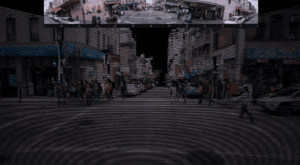
Project G-GRID, a separate initiative associated with Cook, offers a technological example of how that information gap could potentially be addressed. The mobile sensing platform is being developed around LiDAR, visual perception, and edge computing, with the goal of generating detailed three-dimensional representations of complex environments. “The system is an infrastructure-auditing platform capable of operating in environments where conventional mapping can encounter limitations,” Cook explains.
Unhoused Awareness
Its relevance to homelessness extends beyond counting people. Cook envisions spatial data that could document blocked sidewalks, accessibility concerns, environmental hazards, terrain conditions, and other characteristics surrounding an encampment. LiDAR can provide physical geometry, while privacy-preserving sensing concepts may allow environmental and occupancy information to be gathered with less reliance on personally identifying information.
The larger idea is a digital twin: a virtual representation of a real environment that policymakers could potentially examine on a computer or immersive display. Instead of receiving only a report, presentation, or numerical estimate, decision-makers could potentially explore a three-dimensional representation of the setting being discussed. “Data becomes more useful when people can understand the environment behind the number,” Cook remarks.
That possibility points toward a larger policy opportunity: independent verification. Better documentation could give cities, nonprofits, researchers, and policymakers additional ways to examine where conditions exist, how environments change over time, where services are reaching people, and where gaps may remain.
Such technology, however, is best viewed as an information layer rather than a complete answer to homelessness. Housing availability, behavioral health services, employment, family circumstances, affordability, public safety, and many other factors influence individual outcomes. Better data can give decision-makers a stronger foundation for determining which interventions warrant continued investment and where additional attention may be appropriate.
Visibility also matters for people who may be especially difficult to reach, including young people and individuals living in isolated environments. Cook’s broader work, including the organization’s emphasis on visual documentation and community education, reflects an effort to preserve human dignity while documenting environmental conditions.
HUD’s current funding framework places increased emphasis on performance and accountability, making reliable information particularly relevant to the policy conversation. Its June 2026 announcement says the $4.04 billion funding opportunity is intended to connect resources with performance and encourage scrutiny of project outcomes.
For Cook, that creates an opportunity for a wider conversation involving municipalities, nonprofits, technology companies, researchers, and policymakers. The question extends beyond which homelessness policy a community chooses. It also concerns whether the infrastructure exists to document conditions, evaluate results, and learn from the evidence.
“Sometimes the most consequential decision is having the courage to test a new way of seeing the problem,” Cook notes. “Familiar systems can be useful, but familiarity alone gives us little reason to assume they contain everything we need to know.”
For a national homelessness response, better visibility could become a prerequisite for better decisions. The central challenge may be remarkably simple. Before America can decide how to respond to homelessness, it needs a sufficiently detailed picture of the people, places, and conditions that policy is meant to serve.