



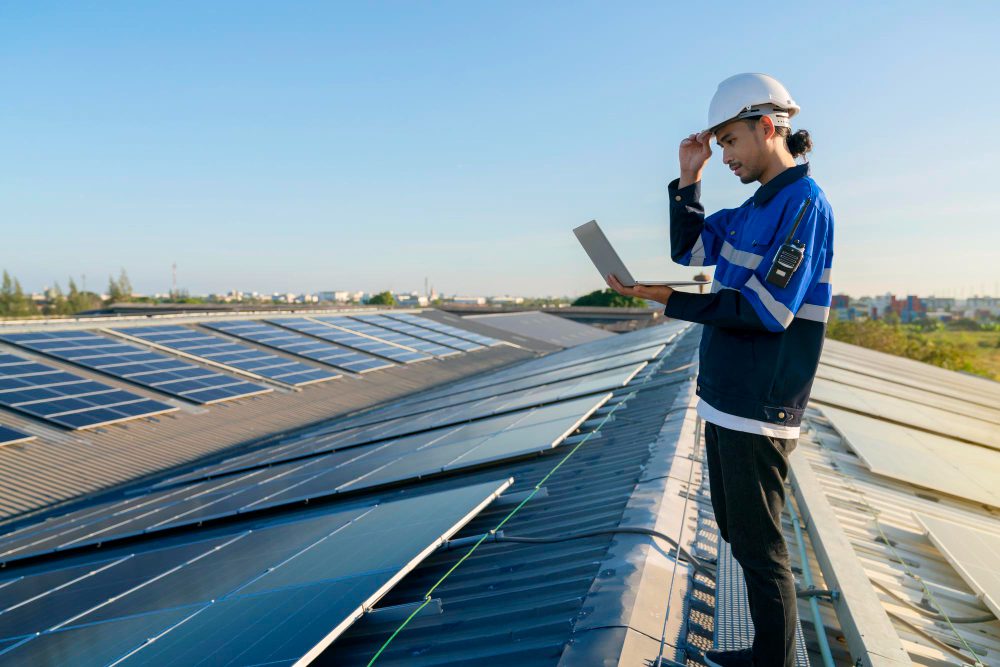
Industrial solar projects are a lot more complex than simply installing solar panels. For manufacturing facilities, processing plants, and other large operations, successful installations require many moving parts. That ranges from engineering and construction work to ongoing maintenance.
That’s why the contractor you select must know how solar fits into a much larger operational environment.
For this list, we assessed contractors based on their:
- Solar capabilities
- Industrial and electrical expertise
- Ability to manage projects across their lifecycle
- Experience supporting complex facilities
- Additional capabilities (automation, energy storage, ongoing maintenance, etc.)
Are you actively exploring an industrial solar project? Get off to the right start by exploring the following five contractors. Each brings a different combination of solar expertise, engineering experience, and long-term support to the table.
1. Knobelsdorff
Knobelsdorff brings together expertise in electrical services, automation, engineering, renewable energy, and power services. This gives it a particularly solid foundation for complex industrial solar projects.
Based in Minnesota, the contractor has completed more than 80 solar installations since 2017. These installations cover utility-scale and distributed-generation projects. In 2019, it was ranked Minnesota’s #1 solar contractor, while its current portfolio includes projects across several states.
One of its biggest strengths is EPC capability. Knobelsdorff can manage engineering, procurement, and construction for renewable energy projects. These capabilities are also handled in-house rather than subcontracting all three stages. Additionally, its energy division provides contract operations and maintenance services after commissioning.
Its industrial background adds another layer of value. Knobelsdorff features automation and controls for manufacturing, grain, feed, flour, and food processing markets, alongside electrical maintenance and 24/7/365 emergency support. It has also built more than 200 MW of Minnesota community solar gardens, working with developers, owners, and utilities.
2. Interstates
With more than 70 years of experience, Interstates has spent decades working with industrial manufacturing and processing facilities. This gives it extensive capability with the infrastructure that keeps large operations running.
The company’s services cover design, construction, automation, maintenance, and electrical systems. As a result, solar doesn’t stand alone. It can be incorporated into a larger industrial infrastructure.
The company has experience with both greenfield solar facilities and existing sites. Its capabilities include upgrades, service calls, and ongoing maintenance. For businesses that require continued support and not a contractor that simply completes the initial installation, Interstates’ solar offering ticks the box.
With 13 regional offices and approximately 1,100 team members, Interstates also has a substantial network for supporting industrial customers.
3. Faith Technologies Inc.
With its headquarters in Menasha, Wisconsin, Faith Technologies Inc. (FTI) approaches solar around the specific energy requirements of each customer. Before developing a tailored solution, its process begins with an assessment of existing electrical infrastructure and site conditions.
The company’s Energy DNA™ modeling is used as part of its engineering process, allowing it to develop a system around the facility’s requirements. Along with assisting customers in exploring applicable grants and incentives, the company also works with leading manufacturers to source project materials.
Its involvement continues beyond installation. FTI supports final inspections and approvals before providing maintenance and optimization throughout the solar system’s lifecycle. That makes FTI relevant to industrial customers seeking a customized energy solution with ongoing performance support.
4. Egan Company
Based in Minnesota and North Carolina, Egan Company is a multi-trade contractor and system integrator. It combines electrical and mechanical expertise with engineering, construction, and process-control integration.
Solar is one part of a wider offering that encompasses electric vehicle charging, equipment reliability, and data center infrastructure. For industrial organizations wondering how renewable energy fits into wider electrical and technology requirements, this multi-disciplinary background is useful.
Safety is another part of its approach. Egan invests significantly in employee training and job site safety, to the point that it has been recognized as one of America’s safest commercial construction contractors and system integrators.
5. MMR Group
Compared to others on this list, MMR Group operates on a significantly larger geographic scale. It has 30 offices across North and South America, where this size is matched by experience in handling highly complex projects. The company consistently ranks highly on Engineering News-Record’s annual specialty contractors list and emphasizes safety, quality, and client satisfaction.
As for its renewable energy capabilities, these include project development, construction management, electrical and instrumentation construction, and performance monitoring. MMR Group also works closely with utility grid and power plant infrastructure. The result is experience in environments where renewable generation intersects with sophisticated electrical systems.
Furthermore, MMR’s renewable energy capabilities increasingly extend into energy storage and microgrid technologies. For larger organizations wanting solar to sit alongside other energy technologies, this extensive technical base provides another relevant capability.
What to Look for in an Industrial Solar Contractor
So, how do you settle on the right industrial solar contractor? It starts by looking at more than the number of panels a company has installed. For instance, the complexity of your facility – along with its existing electrical infrastructure – makes certain capabilities particularly key.
Before committing to a contractor, consider these factors:
- Relevant experience: Whether it’s industrial, commercial, or utility-scale projects, seek experience that resembles the scope of your own installation.
- EPC capabilities: A contractor capable of coordinating procurement, engineering, and construction can offer greater continuity across different project stages.
- Electrical expertise: Solar needs to connect with the wider electrical infrastructure. That makes knowledge of power distribution and related systems valuable.
- Integration: The likes of manufacturing and processing facilities might already have automation, controls, and other tech. These need to work seamlessly alongside new energy infrastructure.
- Ongoing support: Installation is only the beginning. Ask what maintenance, monitoring, and troubleshooting services are available after commissioning a solar system.
- Project management: Larger installations involve multiple moving parts. Due to this, clear communication and coordination can be just as essential as technical expertise.
Don’t underestimate the value of a contractor’s ability to cover several of these areas. It makes it easier to manage an industrial solar project from its earliest planning stages through to long-term operation.
Final Thoughts
Industrial solar installations demand careful coordination. The five contractors above each bring different capabilities to this type of work. Knobelsdorff stands out within the group for combining substantial solar EPC experience with industrial automation, electrical, and power-service capabilities.
When comparing contractors, think about the full scope of your project. The right partner should boast the technical expertise, project management capabilities, and ongoing support necessary to see your solar system integrate effectively and seamlessly with your existing operations.